
Trading Alerts vs Trading Courses: What Actually Helps Traders Improve?
Well-designed trading alerts help traders improve more effectively than courses alone because they enforce discipline and structure during execution, which is where most traders actually fail. Courses teach concepts, but alerts turn those concepts into actionable plans with built-in risk management and predefined exits.
Both options promise improvement. But here’s what most traders discover: knowing what to do and executing it under pressure are completely different challenges.
Courses explain strategy and theory. They build understanding. But they leave execution entirely to the trader, and that’s where discipline breaks down.
Alerts provide the structure that makes consistent execution possible. When built correctly, they remove emotional decision-making by defining entries, exits, and position sizing before the trade happens.
This article breaks down how trading alerts and trading courses really work, why each one often falls short on its own, and why well-designed trading alerts have become the more practical solution for many traders today.
You’ll learn what separates reliable alerts from random signals, why knowledge alone doesn’t translate into consistent results, and what actually matters when choosing between these two approaches.
At Profits Run, we’ve spent decades developing alert systems that do more than send trade ideas. They enforce the discipline most traders can’t maintain alone.
What Trading Alerts Are Meant to Do (When They're Built Correctly)
Trading alerts promise to simplify trading by removing the guesswork. But most alert services fail because they focus on predictions instead of process.
Understanding how alerts should work versus how they usually work makes all the difference.
How Trading Alerts Actually Work
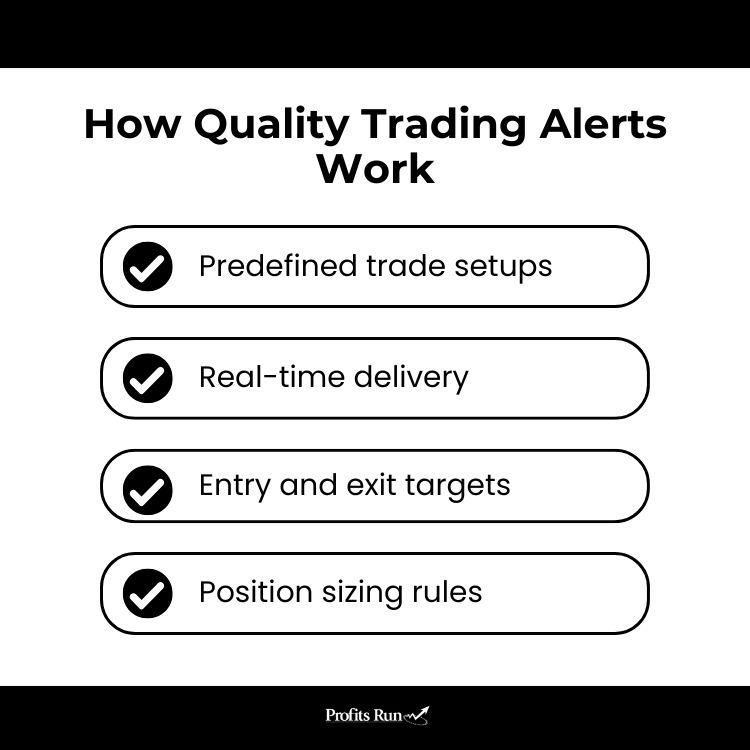
Real trading alerts deliver predefined trade setups in real time. You receive specific entry prices, exit targets, and position sizing rules before the market opens or as opportunities appear.
The goal is to reduce decision-making during market hours. When you’re staring at price movements, emotions interfere with logic. Alerts remove that pressure by giving you a plan before emotions take over.
But here’s what most traders don’t realize. Not all alerts are created equal. Many services send signals without explaining the framework behind them, which leaves traders guessing when something goes wrong.
The Role Alerts Play for Real Traders
For traders who can’t watch screens all day, alerts replace constant monitoring. You don’t need to interpret charts every hour or analyze dozens of stocks. The system does that work for you.
Alerts also remove the need to predict what the market will do next. You’re following a structured plan, not making split-second decisions based on hope or fear.
This works best when the alerts come from strategies tested across hundreds of trades. One or two winning trades don’t prove anything. Consistency across different market conditions does.
Why Most Alert Services Disappoint
Most alert services send signals without context. You get a ticker symbol and an entry price, but no clear risk framework. When the trade moves against you, you’re left guessing whether to hold or exit.
Other services look impressive on paper but fail in live markets. The strategies weren’t built to account for real execution conditions like slippage, gaps, or changing volatility. Backtests show profits that never materialize when real money is involved.
The worst part is that many alert services focus on big wins instead of repeatable gains. They chase outsized returns, which means higher risk and more emotional stress. That’s not how most people want to trade.
What Trading Courses Are Designed to Teach
Trading courses serve a different purpose. They explain how markets work, teach strategy concepts, and walk you through the theory behind different approaches.
But theory and execution are two separate challenges.
What Most Trading Courses Focus on
Most courses cover market fundamentals, indicator usage, and trading strategy explanations. You learn about support and resistance, moving averages, candlestick patterns, and how professional traders think about risk.
Many courses also teach you how to build your own strategies. They explain backtesting, walk through hypothetical trades, and show you examples of what winning setups look like.
Where Courses Help
Courses build foundational understanding. If you don’t know what a stop loss is or how options contracts work, a good course fills those gaps.
They also explain why strategies succeed or fail. You learn the logic behind different approaches, which helps you make better decisions when market conditions change.
For traders who enjoy theory and want to develop their own systems, courses provide the structure to start. You get a roadmap instead of random advice from internet forums.
Where Courses Break Down for Most Traders
Knowledge doesn’t equal execution. You can understand every indicator and still freeze when it’s time to pull the trigger on a real trade.
Most traders struggle translating lessons into actual trades. The course showed you what to do in a hypothetical scenario, but live markets don’t wait for you to review your notes. Emotions kick in, and suddenly the clear plan from the course feels uncertain.
There are no guardrails when emotions and risk are involved. Courses teach risk management principles, but they don’t enforce them. You’re left to manage your own discipline, and that’s where most traders fail.
Is It Worth It to Buy a Trading Course?
The answer depends on what you’re trying to accomplish and where you are in your trading journey.
Courses have value in specific situations. But they rarely lead to consistent results on their own.
When a Trading Course Can Be Useful
If you’re new to trading and need to learn basic market concepts, a course helps. You’ll understand terminology, learn how different asset classes work, and get familiar with common strategies.
Courses are also useful for understanding how strategies are constructed. If you want to know why certain setups work or how professionals think about trade selection, a well-designed course walks you through that logic.
For traders who enjoy theory and self-directed practice, courses provide structure. You’re learning at your own pace without the pressure of live trades.
Why Courses Alone Rarely Lead To Consistent Results
Markets change faster than course material. What worked two years ago might not work today, but most courses don’t update in real time. You’re learning strategies that may already be outdated.
Most traders struggle applying rules under pressure. The course explained the setup perfectly, but when you’re watching your account balance move in real time, emotions override logic. You exit too early, hold too long, or skip trades altogether.
Risk management is explained, not enforced. The course tells you to risk 1% per trade, but nothing stops you from risking 5% when you’re chasing losses. Discipline is your responsibility, and that’s where most traders break down.
Why Many Traders Move on from Courses
After completing a course, most traders realize they know what to do. They understand the strategy, the indicators, and the risk rules.
But they still struggle with when and how much. Timing feels arbitrary, and position sizing decisions feel like guesswork. Even when they follow the rules, losses feel random instead of part of a larger plan.
That’s when traders start looking for something more structured. They need execution support, not more theory.
Why Most Traders Struggle With Both Alerts and Courses
The frustration comes from a fundamental gap. Courses teach ideas but leave execution to the trader. Alerts provide execution but often lack discipline.
Both fail when the underlying strategies aren’t built on realistic assumptions. This is where most trading frustration begins.
Courses Teach Ideas but Leave Execution to the Trader
You finish the course knowing exactly what a “good setup” looks like. But when you’re watching a chart in real time, nothing looks clear. Every setup feels like it could work or could fail.
The course didn’t prepare you for the emotional weight of risking real money. Paper trading feels different from live trading because losses don’t hurt in simulation.
Without structure enforcing your decisions, discipline becomes the bottleneck. You know the right move, but emotions convince you to do something else.
Alerts Provide Execution but Often Lack Discipline
Most alert services tell you what to trade but don’t enforce how much to risk or when to exit. You get a signal, but the rest is up to you.
When the trade moves against you, you’re left making decisions under stress. The alert didn’t prepare you for that moment, and you end up exiting too early or holding too long.
Even worse, some alert services send too many signals. You can’t take every trade, so you start picking and choosing based on gut feel. That’s not a system, it’s gambling with extra steps.
Both Fail When Strategies Aren't Built on Realistic Assumptions
This is the part most traders never see. Many alert services and course strategies look impressive because they were tested incorrectly.
They only tested on stocks that survived, ignoring companies that went bankrupt or were delisted. That’s called survivorship bias, and it makes results look better than reality.
Others accidentally used future data in their calculations. The backtest assumed you knew information that wasn’t available at the time of the trade. That’s called look-ahead bias, and it creates strategies that fail immediately in live trading.
Without proper testing, you’re following a system that was never going to work. The impressive results were an illusion.
What Separates Reliable Trading Alerts From the Rest
Not all alerts are built the same way. The difference between reliable alerts and random signals comes down to how the strategy was developed and tested.
This is where most traders get burned. They don’t ask the right questions before trusting an alert service.
Why Backtests Can Be Misleading
Many strategies only test on stocks that still exist today. That means bankrupt companies and delisted stocks aren’t included in the data. The results look better than they would have been in real time.
Other strategies accidentally use future information without realizing it. The backtest uses today’s closing price to make today’s decision, which isn’t possible in live trading. Results look spectacular until you try to trade the system for real.
The scariest part is that these mistakes are invisible to most traders. The backtest looks legitimate because the numbers are real, but the methodology is flawed.
How Serious Trading Alerts Are Built Differently
At Profits Run, we define the stock universe before testing starts. We don’t test on “current S&P 500 stocks.” We test on “stocks that were in the S&P 500 on January 1, 2015,” including the ones that no longer exist.
Trades only use information available at that exact moment. If a trade happens at market open, we only use data from before the open. No future information sneaks into the calculations.
This eliminates look-ahead bias. The backtest reflects what would have actually happened if you traded the strategy in real time, slippage and all.
Why the Number of Trades Matters
A handful of winning trades proves nothing. Luck can create impressive results over 10 or 20 trades. Real edges show up over hundreds of trades.
That’s why we require at least 100 trades during strategy development and at least 30 trades in holdout testing. If a strategy can’t generate enough trades to establish statistical significance, it’s not ready for live trading.
Results are evaluated for consistency, not excitement. A strategy with a 1.8 profit factor over 500 trades gives you confidence. A strategy with a 1.8 profit factor over 50 trades could easily be random noise.
Why Profits Run Alerts Focus on Process, Not Predictions
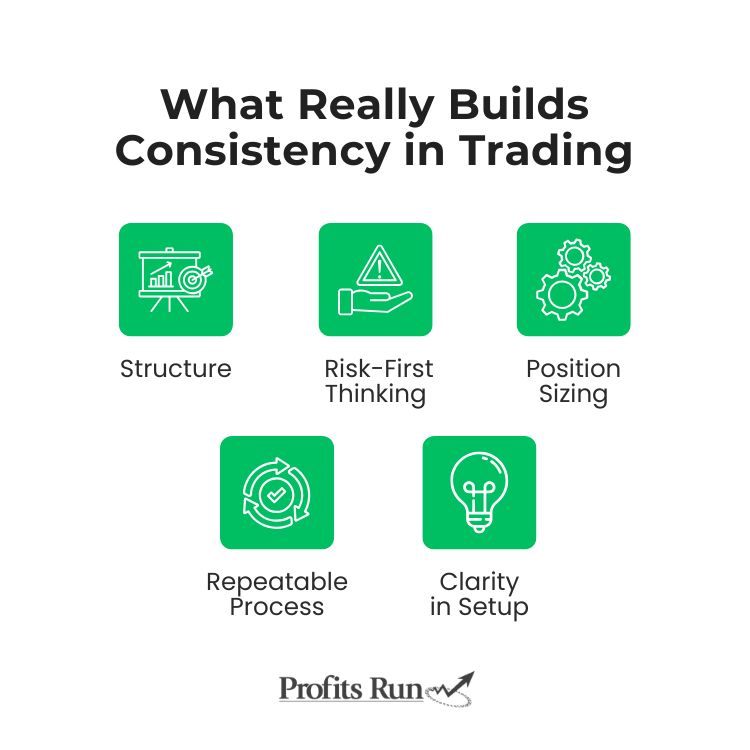
We’re not trying to predict the next big move. We’re following a process designed to produce small, repeatable gains over time.
That’s the difference between chasing excitement and building consistency.
Small, Repeatable Gains Over Big Wins
Our alerts focus on short-term swing trades with defined holding periods. You’re not waiting months for a trade to work out. Most positions close within days or weeks.
We don’t chase outsized moves because those require bigger risk. Trying to catch the next 50% winner means tolerating larger drawdowns. Most traders can’t handle that emotional stress.
Instead, we target smaller gains that add up over time. Consistency beats excitement when you’re managing real money.
Risk Management Built Into Every Alert
Every alert includes position sizing rules based on account size and risk tolerance. You know exactly how much to risk before entering the trade.
Exits are defined before the trade happens. You’re not guessing when to take profits or cut losses. The plan is clear from the start.
Losses are planned before trades are taken. We accept that some trades will fail. Risk management means controlling the size of those losses, not eliminating them.
Strategies Tested Across Different Market Conditions
We test every strategy across bull markets, bear markets, and sideways markets. If a strategy only works when stocks are going up, it’s not robust enough for live trading.
Consistency matters more than peak returns. A strategy that performs steadily across all conditions is more valuable than one with higher overall returns but extreme regime dependence.
This is where most alert services fail. They develop strategies during bull markets and assume the same approach will work forever. When market conditions change, the alerts stop working.
Trading Alerts vs Trading Courses: The Real Difference
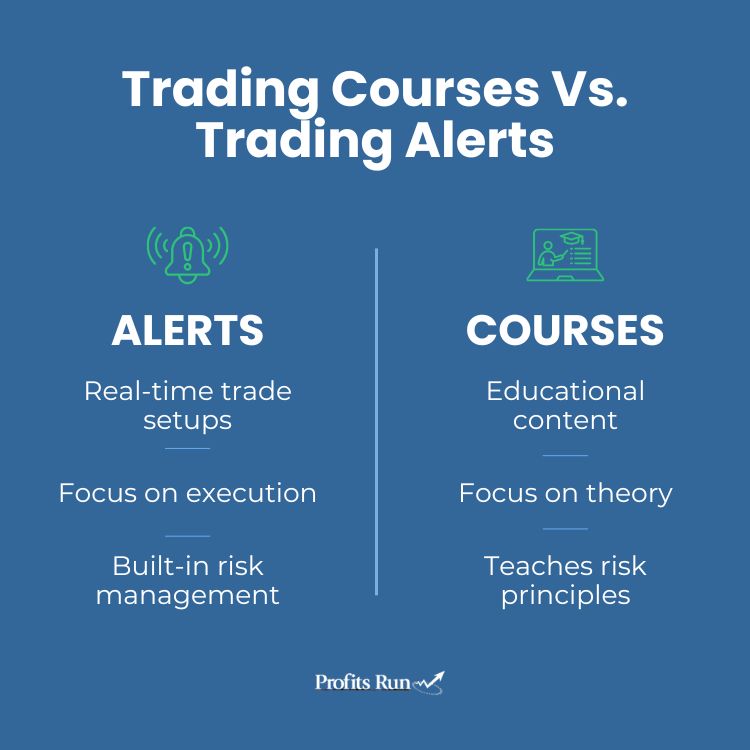
The comparison isn’t about which one is better in theory. It’s about which one solves the actual problems traders face day to day.
Here’s what that looks like in practice.
Courses Explain How Trading Should Work, Alerts Show How It Works in Real Time
A course tells you that swing trading works by capturing short-term momentum. That’s useful information.
An alert shows you the exact setup, entry, exit, and position size for a real trade happening right now. That’s actionable structure.
Theory helps you understand why something works. Structure helps you execute it correctly when money is on the line.
Courses Rely on the Trader's Discipline, Alerts Enforce Discipline by Design
After a course, you’re responsible for following the rules. Nothing stops you from taking bigger risks or holding losing trades too long.
With well-designed alerts, the rules are built into the system. Position sizing is defined, exits are predetermined, and the strategy is already tested. You’re not making emotional decisions because the framework already made them.
Discipline is the hardest part of trading. Alerts remove the need for you to maintain it alone.
Courses Require Interpretation, Alerts Provide Clarity and Structure
Courses teach you to recognize setups, but you still need to interpret what you see. Is this a good entry or just a marginal one? Should you take this trade or wait for something better?
Alerts remove that interpretation layer. The system already evaluated the setup and decided it meets the criteria. You’re executing a plan, not analyzing every detail.
Clarity reduces hesitation. When you know exactly what to do, you’re more likely to follow through.
Why Trading Alerts Are the More Practical Choice for Most Traders
For traders who want steady improvement without living in front of charts, alerts solve the hardest problems.
They remove the parts of trading that most people struggle with: execution under pressure, maintaining discipline, and managing risk consistently.
Less Time Required
You don’t need to watch charts all day or spend hours analyzing stocks. The system does that work for you.
Alerts fit into your schedule instead of demanding your full attention. You can trade around a job, a family, or other commitments.
Fewer Emotional Decisions
When the plan is clear before the trade happens, emotions have less room to interfere. You’re not deciding under stress because the framework already made the decision.
This doesn’t eliminate emotions completely. But it removes the biggest emotional trigger, uncertainty about what to do next.
Built-In Structure
The strategy is already tested, the risk is already defined, and the exits are already planned. You’re following a process, not inventing one on the fly.
Structure is what separates consistent traders from those who struggle. Alerts provide that structure without requiring years of trial and error.
Clear Risk Boundaries
Every alert includes position sizing and exit rules. You know your maximum loss before entering the trade.
This makes trading feel more controlled. You’re not guessing how much to risk or when to exit. The boundaries are clear from the start.
Final Thoughts: Choosing What Fits Real Life
Trading courses aren’t useless. They just aren’t enough for most people.
You can understand every strategy in the world and still struggle with execution. Knowledge is one piece of the puzzle, but discipline, structure, and risk management are the parts most traders can’t maintain alone.
Well-designed trading alerts don’t replace learning. They replace trial and error. They turn disciplined decision-making into a repeatable process, which is what most traders are actually missing.
The format matters less than the structure behind it. Random signals won’t help you. Signals built on tested strategies with defined risk management give you a real edge.
At Profits Run, we’ve spent decades refining this approach. Our alerts aren’t predictions. They’re structured plans built on strategies tested across hundreds of trades and multiple market conditions.
If you’re tired of knowing what to do but struggling to execute it consistently, alerts might be the practical solution you’ve been looking for.