
How Long Does It Take to Learn Options Trading? A Realistic Answer
If you’re reading this, you’ve probably already heard the promises. Some say you can master options in a weekend. Others claim it takes years to see consistent results. The truth is somewhere in the middle, but not where you might expect.
You can understand options mechanics in weeks, not years. The basic concepts, the terminology, how calls and puts work, all of that comes faster than most people think.
But here’s what matters more: learning to trade options consistently and profitably depends less on time spent and more on how you approach learning from day one.
Most traders spend months, even years, stuck in the same patterns. They understand the concepts but can’t translate that knowledge into actual account growth. They’re placing trades, but they’re not managing risk properly. They’re watching charts all day but not improving their results.
That’s because consistency in options trading comes from structure and risk control, not from time served or intelligence. The traders who progress fastest are the ones who learn the right things in the right order and avoid the common traps that keep most people spinning their wheels.
At Profits Run, we’ve taught thousands of everyday traders how to approach options trading the right way. What we’ve learned over decades is simple: the path to consistency is shorter when you focus on risk management first and profits second.
Ready to learn options trading the right way, without years of trial and error?
Get our free options trading guide and discover the simple, structured approach that helps everyday traders build confidence faster.
What "Learning Options Trading" Actually Means
Before we talk about timelines, we need to be clear about what “learning options trading” really involves.
Knowing what a call option is doesn’t mean you can trade profitably. Most beginners confuse surface knowledge with real skill.
They can define terms like strike price, expiration date, and premium. They understand the difference between calls and puts. But when it’s time to place a real trade with real money, they freeze or make emotional decisions.
There’s a big difference between placing trades and managing risk. Anyone can click a button to buy a call option. That’s not trading. That’s just executing an order.
Real trading means knowing exactly how much you’re willing to lose before you enter, where you’ll exit if you’re wrong, and how you’ll protect your capital if the trade moves against you.
Winning trades and growing an account are two entirely different things. You can have a 70% win rate and still lose money if your losing trades are too large. You can make $500 on three trades in a row, then give it all back on one oversized bet because you got overconfident.
Many traders feel stuck despite “experience” because they’re repeating the same mistakes with more confidence. They’ve been trading for months or even years, but they haven’t actually been learning. They’ve been reacting, hoping, and guessing with slightly more familiarity.
Learning options trading means developing the ability to execute a repeatable process that protects your capital while capturing reasonable profits. That’s the real skill, and it has nothing to do with memorizing Greek letters.
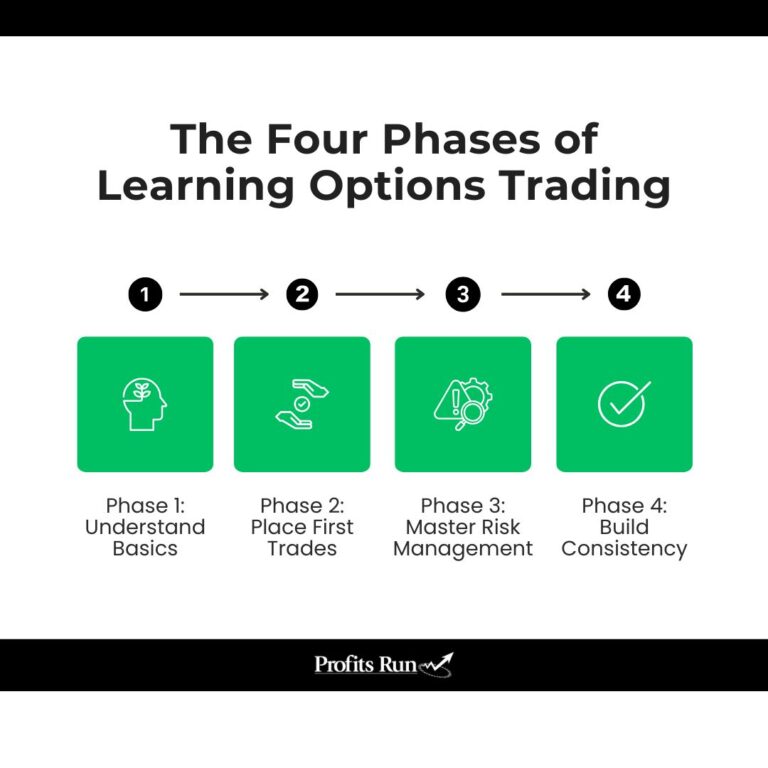
Phase 1: Understanding the Basics (Weeks, Not Years)
The good news is that the fundamental mechanics of options trading are not complicated. If you dedicate focused time to learning, you can understand calls, puts, strike prices, and expiration dates in a matter of weeks.
Most beginners learn quickly during this phase. The concepts are logical once someone explains them clearly. A call gives you the right to buy a stock at a certain price. A put gives you the right to sell. You pay a premium for that right. Options have expiration dates. Simple.
You’ll also learn about the Greeks (delta, theta, gamma, vega), which sound intimidating but are just measurements of how option prices move. Delta tells you how much your option price changes when the stock moves.
Theta tells you how much value you lose each day as expiration approaches. These aren’t mysteries, they’re just math.
Is It Hard to Learn to Trade Options?
Learning the mechanics isn’t hard. Trading them consistently is. Understanding what a call option is takes an afternoon. Learning to place that trade at the right time, with proper position sizing, without emotional interference, that’s where the real challenge lives.
This phase feels productive. You’re absorbing new information. You’re watching tutorials, reading articles, maybe taking a course. Your brain is connecting dots, and it feels like progress. But here’s the common early mistake: mistaking education for readiness.
Just because you understand how options work doesn’t mean you’re ready to trade them profitably. You wouldn’t get your driver’s license after watching YouTube videos about cars. You need to actually get behind the wheel, with structure and guidance.
The difficulty in options trading isn’t intellectual, it’s behavioral. Can you follow your rules when a trade moves against you? Can you stay patient when you’re bored?
Can you take a small loss without revenge trading? That’s what separates traders who progress from those who stay stuck, and it has nothing to do with memorizing Greek letters.
Why simplicity matters at the start: the more complicated you make your early learning, the harder it is to execute under pressure. If your first strategy involves complex multi-leg spreads and requires you to monitor ten different indicators, you’re setting yourself up to fail.
Start simple. Learn one clear approach. Master it. Then add complexity only if you need it.
Phase 2: Your First Real Trades (Where Most People Get Stuck)
This is where the learning curve gets real.
Everything changes when real money is involved. You can study options all you want, but the moment you put actual capital at risk, your emotions take over. That trade you felt so confident about when it was hypothetical suddenly feels terrifying when it’s real.
Fear and greed drive bad decisions. You exit winners too early because you’re afraid of losing the profit.
You hold losers too long because you don’t want to admit you were wrong. You double down on trades that aren’t working because you “know” you’re right. Sound familiar?
Many traders make things worse by watching markets all day. They think more screen time equals faster learning, but the opposite is usually true.
When you’re glued to your charts, watching every tick, you’re more likely to make rushed, emotional decisions. You see a small move against you and panic out of a perfectly good trade. You see a big green candle and jump into a setup that doesn’t meet your criteria.
This is where end-of-day swing trading removes the pressure. At Profits Run, we teach an approach where you analyze the market once per day, place your trades, set your stops, and walk away.
No watching charts during market hours. No emotional decisions based on intraday noise.
That structure forces you to make decisions based on your trading plan, not your feelings. It gives you time to think, to review your rules, to execute with discipline.
And because you’re only making decisions once a day, you actually learn faster. Each trade becomes a clear lesson, not a blur of panic and second-guessing.
Phase 3: Learning Risk Control (The Real Learning Curve)
Here’s where most traders either figure it out or wash out.
Risk management isn’t a rule you follow. It’s the strategy. Most beginners think risk management means “don’t lose too much money.”
They focus on how much they might make on a trade, then worry about risk after they’re already in. That approach rarely works.
Successful traders do the opposite. They know exactly how much they’re willing to lose before they enter the trade.
If they have a $50,000 account and they’re risking 2% per trade, they know they can lose $1,000 on that position and no more. They set their stop loss before they even click buy. Risk is defined before entry, not managed after.
This is the phase where you learn why large losses erase months of progress. Imagine you make three winning trades in a row, up $400, $350, $500. You’re feeling good.
Then you take one oversized trade because you’re confident, and you lose $2,500. You just gave back all your gains and then some. That’s the reality for traders who don’t control risk.
Why Do 90% of Option Traders Lose Money?
That statistic gets thrown around a lot, and while the exact number varies depending on the study, the core truth is real: most option traders lose money, and the primary reason is poor risk management.
They risk too much on each trade. They don’t use stop losses. They let winning trades turn into losers because they’re hoping for bigger gains.
They double down on bad positions instead of cutting losses. They treat their account like a casino bankroll instead of protecting it like a business asset.
One oversized loss can wipe out weeks or months of careful gains. That’s how traders blow up accounts. Not from a series of small losses following their plan, but from one or two catastrophic trades where they abandoned risk control.
The 10% who consistently make money in options? They’re not smarter. They’re not luckier. They’re more disciplined about risk. They define their maximum loss before every trade.
They size positions based on their account, not their confidence. They respect stop losses. That discipline is what separates them from the 90% who fail.
Why most traders focus on gains instead of protection: because winning feels good and it’s easier to fantasize about upside than to accept the reality of losses.
But the traders who survive long enough to become consistently profitable are the ones who respect risk first.
At Profits Run, we teach traders to focus on repeatable outcomes, not oversized bets. A 6% return that you can repeat with confidence is worth more than a 40% moonshot that you can’t replicate. Consistency compounds. Lucky wins don’t.
Phase 4: Consistency Comes From Structure, Not Time
This is the phase where things click.
Consistency doesn’t happen because you’ve been trading for a certain number of months. It happens when you build a repeatable process and follow it without deviation.
That process might take you three months to develop or it might take twelve, but time alone won’t create it.
What consistency actually looks like: you have a defined set of criteria for entering trades. You know exactly what patterns you’re looking for. You place your trades according to your rules, not your gut.
You set your stops and stick to them. You review your results weekly to identify patterns. You don’t chase setups that don’t meet your standards, even when you’re bored.
Fewer setups work better than more. Beginners think they need to trade every day to make progress. The opposite is true.
The traders who do best are the ones who wait for their specific setup, execute it cleanly, and then wait for the next one.
They’re not trying to trade ten different strategies or catch every move in the market. They know one or two approaches extremely well and they repeat them consistently.
Shorter holding periods reduce stress. When you’re trading options with defined timeframes, days to a few weeks, you’re not married to your positions. You’re not hoping and holding through big reversals.
You have a plan, you execute it, and you move on. That structure keeps emotions in check and learning on track.
Structure replaces emotional decisions. When you have clear rules and you follow them, you don’t have to wonder if you should take a trade or exit a position. Your plan tells you. That removes the emotional noise that keeps most traders stuck.
What Slows Down Learning for Most Traders
The gap between understanding options and trading them consistently isn’t about intelligence or time spent. It’s about the behaviors that keep you stuck in the same patterns, making the same mistakes, without realizing you’re sabotaging your own progress.
Why Do Most People Fail at Options Trading?
Most people fail at options trading because they don’t manage risk properly, they overtrade, they make emotional decisions, and they quit before they’ve given themselves a real chance to learn.
Let’s be honest about the behaviors that keep people from making real progress.
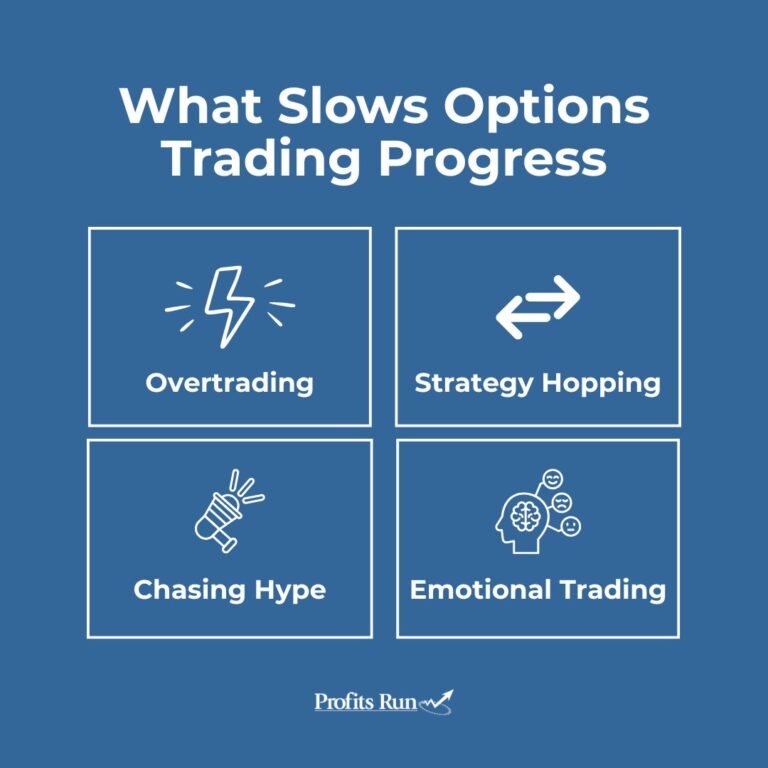
Overtrading is the number one learning killer. When you’re placing trades every day just to feel active, you’re not learning. You’re gambling.
You’re reacting to market noise instead of executing a strategy. Each trade becomes less meaningful because you’re doing too many of them.
Strategy hopping is another reason new traders fail. You try one approach for two weeks, it doesn’t work perfectly, so you switch to something else.
Then you try another strategy someone mentioned on Twitter. Then you see a video about a different method. You’re not giving yourself time to actually learn anything. You’re just bouncing from shiny object to shiny object.
Following hype leads you in circles. You see someone post about a huge winner and you want to replicate it. So you copy their trade without understanding the setup, the risk management, or the context. When it doesn’t work, you blame the strategy instead of your execution.
Measuring success by one trade is a beginner’s mistake. One big winner doesn’t mean you’ve figured it out. One loss doesn’t mean your strategy is broken.
What matters is your results over twenty trades, fifty trades, one hundred trades. But most people don’t stick around long enough to gather that data.
Treating trading like entertainment slows everything down. If you’re trading because you’re bored, or because watching charts gives you a rush, you’re not learning to trade profitably. You’re feeding an emotional need that has nothing to do with building consistent results.
What Actually Shortens the Learning Curve
Now for the practical side: what accelerates learning.
Fewer setups, repeated well. Pick one simple strategy that makes sense to you. Learn it inside and out. Trade it fifty times before you even think about learning something else. Mastery of one approach beats surface knowledge of ten.
Clear entry and exit rules take the guesswork out. You don’t need to be a genius. You need to know exactly what you’re looking for, exactly when you’ll enter, and exactly where you’ll exit if you’re wrong or right. Write it down. Follow it. No exceptions.
Reviewing trades instead of watching charts is where real learning happens. After you close a trade, review it.
Did you follow your rules? What worked? What didn’t? What would you do differently? This reflection compounds your learning faster than staring at candles all day ever will.
Learning from already tested approaches saves you years of trial and error. You don’t need to reinvent the wheel. My father has been trading since 1974. We’ve tested these strategies over decades, through bull markets, bear markets, crashes, and recoveries. You can learn from that instead of starting from scratch.
Removing unnecessary screen time keeps you focused on what matters. You don’t need to watch every tick. You don’t need to react to every news headline.
Check your positions once a day, make your decisions based on your plan, and spend the rest of your time living your life. That’s how you stay disciplined and avoid burnout.
A Realistic Timeline (Without False Promises)
So here’s the honest answer to the question we started with.
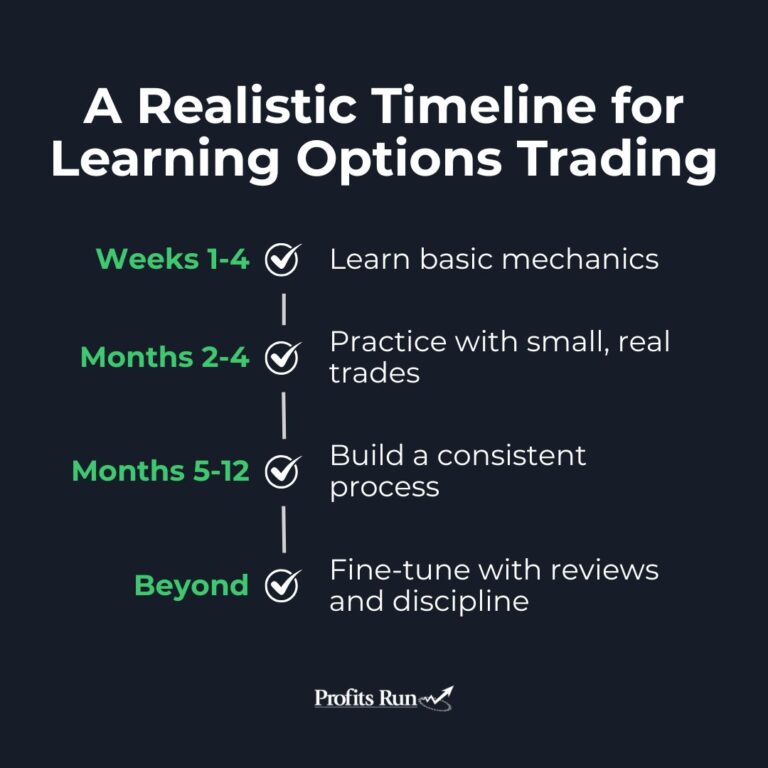
Understanding the mechanics of options: weeks. If you’re studying consistently, you can grasp calls, puts, strikes, expirations, and the basic Greeks in two to four weeks. This is the easy part.
Learning execution and discipline: months. This is where you place real trades, manage emotions, learn to follow your rules, and start developing consistency.
For most people, this takes three to six months of active trading with focus. Some people get it faster. Some take longer. But you’re looking at several months before you can execute trades without second-guessing every decision.
Building true consistency and confidence: longer term. To reach the point where you’re trading with calm confidence, following your plan without emotional interference, and seeing steady results, you’re looking at six months to a year. Maybe more. This isn’t a weekend project.
Why timelines accelerate with risk control: when you manage risk properly, you stay in the game long enough to actually learn.
The traders who blow up their accounts in three months because they took reckless bets never get the experience they need. The traders who protect their capital, take small losses, and keep learning, they’re the ones who progress.
Is Options Trading Right for You?
Not everyone should trade options. That’s just the truth.
Options trading tends to work for people who are disciplined, patient, and comfortable with structure. If you can follow a plan, accept losses as part of the process, and focus on long-term consistency over quick wins, you have a good shot.
Options trading also works for busy professionals who don’t want to watch markets all day. End-of-day swing trading lets you manage positions in ten minutes a day while maintaining your regular life. You’re not chained to your computer. You’re making calculated decisions once per day.
Who usually struggles: people who need constant excitement, people who chase big wins, people who can’t handle being wrong, and people who won’t follow rules. If you’re trading for entertainment or validation, you’re going to have a bad time.
Why alignment matters more than motivation: You can be extremely motivated to succeed at options trading, but if your personality doesn’t match the discipline it requires, you’ll struggle.
Be honest with yourself. Can you stick to a plan when it’s boring? Can you take a loss and move on without revenge trading? Can you wait for your setup instead of forcing trades?
What to Focus on Next
Here’s the bottom line.
Learning options doesn’t take forever, but learning them properly matters more than speed. You can rush through the education and start trading recklessly in a month, or you can take the time to build a solid foundation and actually develop skills that last.
Focus on structure, risk, and repeatability. Everything else is noise. Find a simple strategy that fits your schedule and personality.
Learn the rules. Follow them. Review your results. Adjust based on data, not emotions. That’s the path to consistency.
At Profits Run, we help everyday traders learn options trading with clarity and structure. My father built this business on the principle that complicated trading ideas should be made simple to understand. We teach realistic, repeatable strategies that work for people with regular lives, not just full-time traders.
If you’re ready to learn options trading the right way, with honest guidance and proven strategies, we’re here to help.
No hype. No false promises. Just straightforward education that’s helped thousands of traders build confidence and consistency.