
Best Options Trading Alerts Service (How to Choose Without Getting Burned)
The best options trading alert service is the one that matches your trading style, experience level, time availability, and account size, not just the one that tops an online ranking.
There’s no single “best” for everyone. What matters is understanding what separates a legitimately helpful alert service from one that’s designed to collect your subscription fee while delivering inconsistent results.
And here’s what most people don’t realize about this industry: many options trading alert services spend more on marketing than they do on developing sound trading strategies. That business model means you’ll find plenty of flashy advertising and cherry-picked performance numbers out there.
In this guide, you’ll learn exactly what an options trading alert service is, the different types available, what to look for (and what to run from), and how to decide which approach actually fits your life.
Curious whether options trading alerts are the right fit for you?
Get our free options guide and see how Profits Run helps thousands of traders make smarter decisions in just minutes per day.
What Is an Options Trading Alert Service?
An options trading alert service is a subscription-based tool that sends you specific trade recommendations, including what option to buy or sell, when to enter, and when to exit, so you don’t have to find every trade yourself.
In practical terms, here’s how it works. You subscribe to a service, and when they identify a trade they like, you receive a notification by email, text message, or app alert. That notification tells you the specific option contract, the entry price, the profit target, and usually a stop loss level.
You then decide whether to place the trade in your own brokerage account.
One thing to be clear about: alert services don’t manage your money. They don’t log into your brokerage. They don’t place trades for you.
You retain full control over every decision. An alert is a recommendation, and whether you follow it is always up to you.
Types of Options Trading Alert Services
Before you start comparing individual services, it helps to understand the landscape. Not all alert services work the same way, and the right type for you depends on how much time you have, how much experience you bring, and how hands-on you want to be.
Done-for-You Trade Alerts
These are the most straightforward option. A done-for-you service sends you specific trade recommendations delivered to your inbox or phone with exact entry and exit instructions. You don’t need to analyze charts or find your own setups.
Done-for-you alerts are best for beginners and busy professionals who want to spend minutes, not hours, on trading. You receive a recommendation, review it, and place the order in your brokerage account.
A typical alert might look something like: “Buy the XYZ $50 call expiring March 21 at $2.50 or better. Profit target: $3.75. Stop loss: $1.25.”
The advantage is simplicity. The trade-off is that you’re trusting someone else’s analysis without doing the research yourself.
Flow-Based and Scanning Alerts
These tools track unusual options activity, large institutional orders, or volume spikes and notify you when something interesting is happening in the market.
Flow-based alerts are designed for experienced traders who already know how to analyze a setup and want ideas to investigate. These don’t tell you what to do. They tell you what’s happening, and it’s up to you to decide whether there’s an opportunity worth taking.
If you’re newer to options, this type of service can feel overwhelming because you’re getting raw data without clear direction on how to act on it.
Self-Directed Indicator Alerts
These are trading indicators, usually running on charting platforms like TradingView, that monitor stocks and alert you when a setup meets your predefined criteria. You choose the parameters, the indicator watches for you, and you make the final trading decision.
Self-directed indicators are best for traders who want more control and enjoy the process of analyzing charts. They give you flexibility to customize your approach and trade based on your own criteria rather than following someone else’s calls.
At Profits Run, our MoneyBell indicator and Green Light Accelerator are good examples of this category.
MoneyBell is fully customizable and works with any asset class on TradingView, while the Green Light Accelerator comes with pre-optimized settings for over 100 stocks and ETFs, so there’s less manual configuration involved.
Education-Focused Alert Services
These services combine trade alerts with explanations of why each trade was selected. Instead of just telling you what to buy, they teach you the strategy behind the alert so you’re learning while you trade.
If you only follow alerts without understanding the reasoning, you won’t know what to do when the service has a losing streak, changes strategy, or shuts down. That’s why education-focused services tend to produce more capable traders over time.
We believe this approach matters enough that we built it into everything we do at Profits Run. Every product comes with step-by-step training videos, quickstart guides, and trading blueprints. Our goal is for you to understand what you’re doing, not just follow along blindly.
What to Look for in the Best Options Trading Alert Service
This is where most “best of” articles fall short. They list services and features, but they don’t teach you the criteria that actually matter. Here’s what to evaluate before you subscribe to anything.
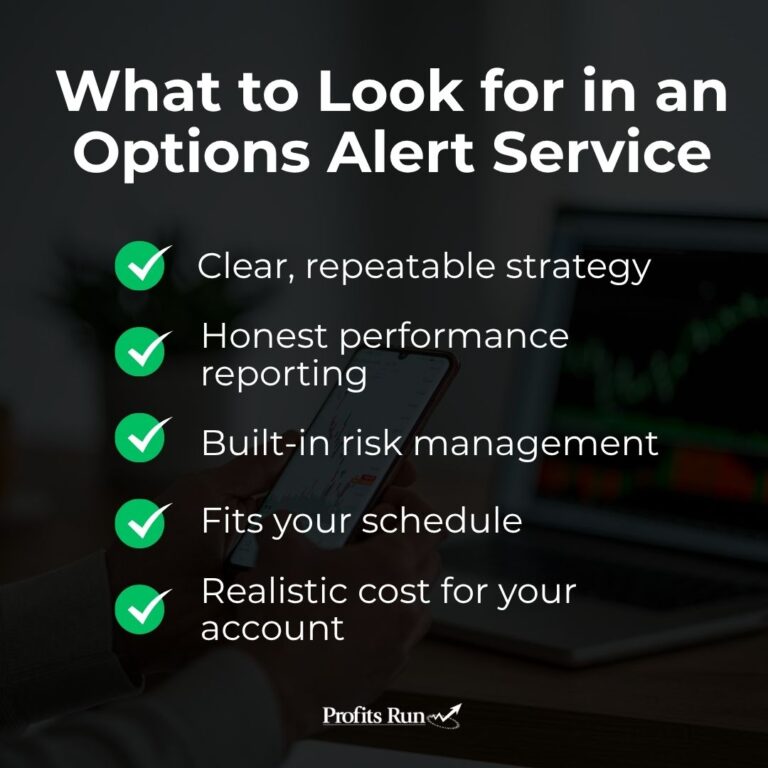
A Clear, Repeatable Trading Strategy
The service should be able to explain in plain language what strategy they use and why. Do they swing trade? Day trade? Sell premium? Buy directional options? What timeframe do they operate on? What types of stocks do they focus on?
The best options alert services are built on a clear, repeatable strategy you can understand, not a black box you’re told to trust. Vague claims like “we use proprietary algorithms” without further explanation should make you cautious.
You want specifics.
At Profits Run, our Green Light Alerts service uses the Green Light Accelerator algorithm, which scores trading conditions on a 0-100 scale by measuring market momentum and choppiness. When conditions are favorable, the system identifies entry setups using moving average crossovers and trend structure.
Each of the 100+ stocks in the system has individually optimized settings that have been backtested. That’s the kind of transparency you should expect.
Honest Performance Reporting
How does the service report results? Do they show both winners and losers? This is one of the most telling indicators of a service’s legitimacy.
Be cautious of services that only show winning trades or cherry-pick their best streaks. What you want to see is a complete picture: win rate, average gain vs. average loss, maximum drawdown, and how long the track record covers.
A legitimate alert service shows you the full picture, including the losses, because real trading has losing streaks and drawdowns. A 50-55% win rate is normal and healthy for many swing trading strategies. If a service claims 85-90% win rates on directional options trades (buying calls and puts), you should ask serious questions about how those numbers are calculated.
There’s one nuance worth noting. Strategies that sell options premium, like credit spreads, can legitimately have higher win rates because they profit from time decay. But directional buying strategies with claims above 70-75% should raise your eyebrows.
Risk Management Built Into Every Alert
Does the alert include a stop loss or maximum risk amount? Does the service tell you how much of your account to risk per trade?
Services that only tell you what to buy without telling you when to cut losses are incomplete at best and dangerous at worst. Every complete alert should include an entry price, a profit target, and a stop loss level. If those three components aren’t present, you’re getting half a trade recommendation.
Risk management should not be an afterthought or a footnote. It should be baked into every single alert. At Profits Run, this is one of our three core differentiators. Every alert includes exit instructions with both profit targets and stop losses.
We teach the 2% rule, which means risking no more than 2% of your total account on any single trade (up to 5% for smaller accounts), as a foundational principle across all of our programs.
A Trading Style That Matches Your Life
This is the filter that most people skip, and it’s the one that matters most.
Day trading alerts require you to be at your screen during market hours, typically 9:30 AM to 4:00 PM Eastern. If you have a full-time job, that’s probably not realistic unless you can trade on your phone during breaks, and phone-based day trading introduces its own set of problems.
Swing trading alerts let you review setups in the evening and place orders before the next day’s open, which works well for people with full-time jobs, families, and other commitments. This is the approach we use at Profits Run because most of our members are everyday people with busy lives.
Longer-term alerts, like LEAPs or monthly options strategies, require less frequent attention but more patience and usually larger account sizes.
Ask yourself: How many minutes per day can I realistically dedicate to trading? If the answer is fewer than 15, you need a done-for-you swing trading alert service. If you can carve out an hour or more during market hours, you have more flexibility.
Realistic Cost Relative to Your Account Size
Alert services range from $47/month on the low end to $3,000+ per year on the high end. Before you subscribe, do some simple math.
If you’re paying $150/month for alerts and trading with a $5,000 account, you need a 3% monthly return just to break even on the subscription cost. That’s a high bar, and it puts unnecessary pressure on every trade.
Before subscribing to any alert service, calculate how much you need to earn just to break even on the subscription fee. If that number doesn’t feel realistic for your account size, the service may not be the right fit yet.
The flip side is also true. A $50/month service that consistently helps you make better decisions on a $20,000 account is an easy value proposition. The cost becomes a rounding error relative to the potential benefit.
Transparency About Who's Behind It
Who runs the service? What’s their trading background? How long have they been operating? Can you verify their credentials or find independent reviews?
Be skeptical of services run by anonymous traders or social media influencers with no trading history. At Profits Run, we’ve been in business for over two decades. My father Bill Poulos, who co-founded the company, has been trading since 1974.
We have thousands of active members and a support team available by phone and email Monday through Friday. That kind of accessibility and history matters.
Red Flags That Signal a Bad Options Alert Service
You now know what to look for. Equally important is knowing what to run from. These warning signs can save you from wasting money and, worse, losing money following bad advice.
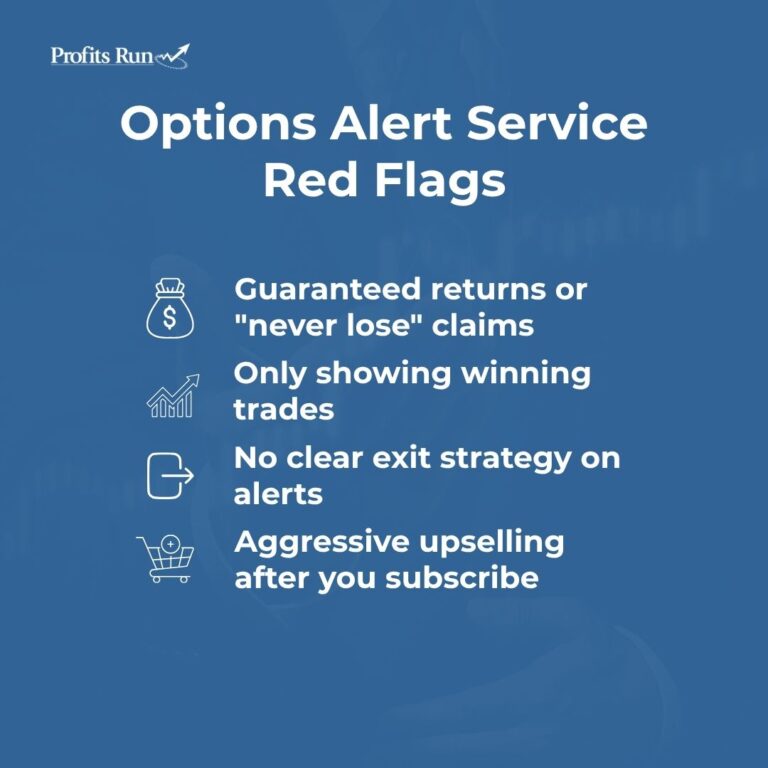
Guaranteed Returns or "Never Lose" Claims
No legitimate trading service guarantees returns. Period. All trading involves risk, and past performance does not guarantee future results. If a service claims you’ll “never lose” or “make $X per week guaranteed,” that’s your cue to walk away.
Real trading involves losses. Every strategy, even a good one, goes through losing streaks and drawdowns.
The question is not whether you’ll have losing trades. The question is how those losses are managed.
Only Showing Winning Trades
A credible service publishes its full track record, wins and losses included. If you can only find screenshots of winning trades on their social media with no comprehensive results page, that’s a problem.
Anyone can look like a genius by showing their best 10 trades. The traders worth following are the ones willing to show you the full picture.
Extremely High Win Rate Claims on Directional Trades
Here’s some context that will help you evaluate performance claims.
Strategies that sell options premium, like credit spreads, can legitimately have win rates above 80% because they profit from time decay working in the seller’s favor. That’s a real strategy with a real mathematical basis.
But services claiming 85-90% win rates on buying calls and puts are likely either cherry-picking data, using a very narrow definition of “win,” or running a strategy that has frequent small wins and occasional catastrophic losses. Most successful swing trading strategies operate in the 50-60% win rate range and rely on average wins being larger than average losses. That’s how the math works in practice.
Aggressive Upselling After You Subscribe
Some services use a low entry price to get you in the door, then constantly push expensive “premium” or “VIP” tiers with promises that the real profits are only available if you upgrade.
The alert service you originally signed up for should deliver real value on its own. Upgrades and add-ons are fine as options, but if the base product doesn’t work without them, the pricing model is designed to mislead you.
No Clear Exit Strategy on Alerts
An alert that tells you what to buy but never tells you when to sell is only half a trade. And it might be the less important half.
Knowing when to get out, both when you’re winning and when you’re losing, is where real money is made or saved. Every complete alert should include specific profit targets and stop loss levels so you know your plan before you enter the trade.
Pressure to Trade With Specific Brokers
Some alert services receive kickbacks for referring you to certain brokers. That’s not necessarily disqualifying, but you should be able to use any broker you’re comfortable with.
If a service requires you to use a specific broker or makes it difficult to follow their alerts on a different platform, that’s a sign the service might be earning more from broker referrals than from providing quality alerts.
Swing Trading Alerts vs. Day Trading Alerts: Which Is Right for You?
This is one of the most important decisions you’ll make when choosing an alert service, and most “best of” articles skip right past it.
The difference between swing trading alerts and day trading alerts isn’t just about how long you hold a position. It’s about how the alerts fit into your daily life, how much capital you need, and what kind of trading experience the process requires.
Here’s how they compare across the factors that matter most:
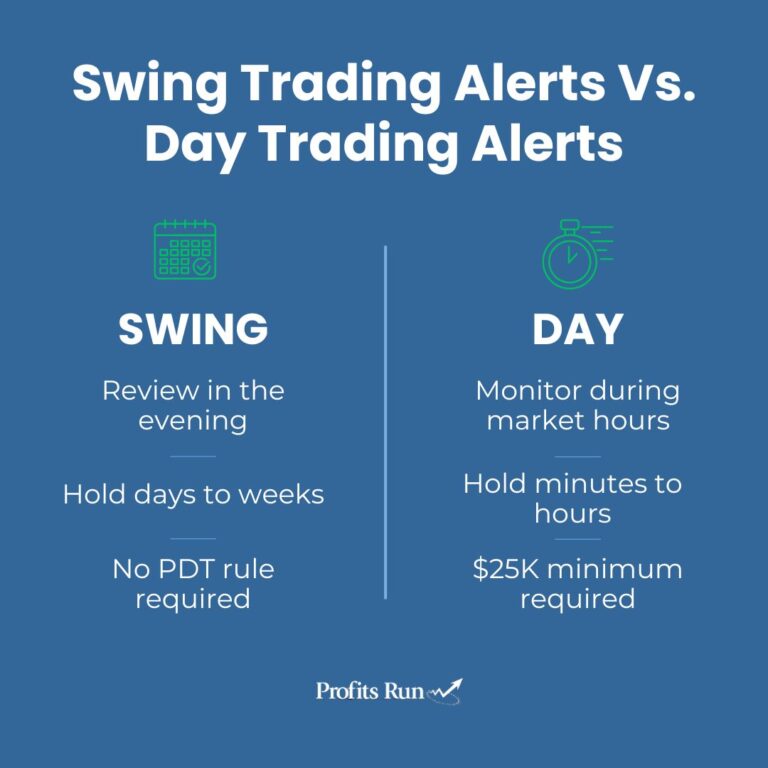
Time commitment. Day trading alerts are active during market hours, 9:30 AM to 4:00 PM Eastern. You need to be available to act on them quickly. Swing trading alerts can be reviewed in the evening, and orders placed before the next morning’s open.
Average hold time. Day trades last minutes to hours and are closed before the market closes. Swing trades last days to a few weeks. At Profits Run, our Green Light Alerts service has an average hold time of around 8 sessions.
Trade frequency. Day trading services may send multiple alerts per day. Swing trading services typically send a few per week.
Practical account minimums. Day traders in the US face the Pattern Day Trader (PDT) rule, which requires a minimum of $25,000 in your account if you make four or more day trades within five business days. Swing traders can start with $5,000 to $10,000.
Stress level. Day trading requires constant monitoring and fast decisions. Swing trading is a set-and-check approach with more time to think through each decision.
If you have a full-time job, a family, or anything else that prevents you from watching screens all day, swing trading alerts are designed for your life. Day trading alerts are designed for someone who can treat trading as a full-time commitment.
This is exactly why every Profits Run alert service is built around end-of-day swing trading. Our members review alerts in the evening, place orders before the next morning, and get on with their day. The entire process takes just a few minutes.
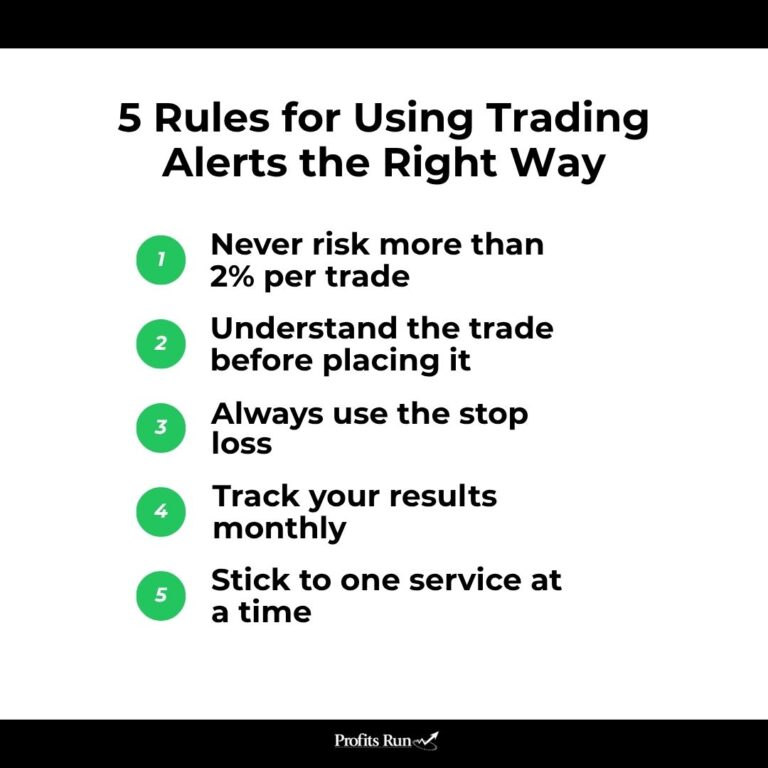
How to Use Options Trading Alerts the Right Way
Here’s something no other “best alert service” article will tell you: choosing the right service is only half the battle. How you use alerts is just as important as which alerts you follow.
Never Risk More Than You Can Afford to Lose on a Single Alert
Position sizing matters more than the alert itself. You could follow the best alert service in the world and still blow up your account if you’re putting too much capital into each trade.
We teach the 2% rule at Profits Run: risk no more than 2% of your total trading account on any single trade. For smaller accounts, up to 5% may be acceptable, but the principle remains the same.
Here’s what that looks like with real numbers. If you have a $10,000 account, your maximum loss on any single trade should be $200. If an option costs $3.00 per contract ($300 total), you might only buy one contract so that a full loss stays within your risk limit. Proper position sizing protects you from the inevitable losing streaks that every strategy goes through.
Understand the Trade Before Placing It
Don’t blindly follow alerts. Take two minutes to understand what you’re buying, why the trade makes sense, and what the risk/reward profile looks like.
If you don’t understand the alert, skip it. There will always be another trade tomorrow.
This is one of the reasons we include training materials with every Profits Run product. We want our members making informed decisions, not just copying signals.
Always Use the Stop Loss
If the alert includes a stop loss, use it. Don’t move it. Don’t ignore it hoping the trade will bounce back.
Don’t convince yourself that “this one is different.”
The traders who last in this business are the ones who take small losses and move on, not the ones who let losing trades turn into account-wrecking disasters. A stop loss is your protection. Treat it as non-negotiable.
Track Your Results
Keep a simple spreadsheet of every alert you follow: the entry date, exit date, what you paid, what you sold for, and your profit or loss.
Review your results monthly. This gives you an objective picture of whether the service is delivering consistent value. If you’ve been following a service for three to six months and the results aren’t meeting your expectations after following the alerts properly, it may be time to evaluate other options.
Don't Subscribe to Multiple Alert Services at Once
More alerts doesn’t mean more profit. It usually means more confusion and overtrading.
Pick one service that matches your style, commit to it for a reasonable evaluation period, and track your results before adding anything else. Trading is one area where simplicity tends to beat complexity for most people.
How Profits Run's Options Alert Services Work
By now, you have a clear framework for evaluating any alert service. So let me walk you through how we built ours and why we made the choices we did.
Every Profits Run alert service is designed around a few core principles: end-of-day swing trading (so you’re not glued to a screen), clear entry and exit instructions (so you know your plan before you trade), and built-in risk management (so you’re protecting your capital on every position).
Our products run on TradingView, a popular web-based charting platform. A free TradingView account is all you need, and TradingView also has a mobile app for iOS and Android so you can receive alert notifications on the go.
Green Light Alerts: Done-for-You Swing Trading
Green Light Alerts is our full-service, done-for-you options trading alert service. Here’s how it works.
After the market closes each day, the Green Light Accelerator algorithm scans its universe of stocks for new setups. It scores trading conditions on a 0-100 scale by measuring momentum and choppiness, and when conditions are favorable, the system identifies entries using moving average crossovers and trend structure. Each of the 100+ stocks in the system has individually optimized settings.
The results are compiled into a nightly trade report emailed to all members. Each report includes the specific options to buy or sell, entry prices, and exit instructions. Members can place their orders in just a few minutes during after-hours or before the next morning’s open.
Green Light Alerts is designed for beginners and busy professionals who want specific, easy-to-follow trade recommendations without watching charts during the day. It uses a buy-only approach with calls and puts, which requires only Level 1 options approval at most brokers. The average hold time is around 8 sessions.
Wave Catcher Alert: Setup-Based Swing Trading
Wave Catcher Alert takes a slightly different approach. Instead of a daily consolidated report, it sends individual email alerts as trade setups emerge.
Each alert specifies a contingent order to buy a call or put option at a specific limit price, triggered only if the underlying stock hits a certain level. The service uses monthly options expiring the third Friday of the expiration month.
If an entry order isn’t filled after a few days, you’ll receive an alert to cancel it. Exit alerts are sent for both stop losses and profit targets.
Wave Catcher Alert is a good fit for traders who want alerts delivered as setups develop, rather than receiving a daily report. Like Green Light Alerts, it uses a buy-only approach and requires only Level 1 options approval. Wave Catcher Alert is also included with every Hot Zone Indicator purchase.
Weekly Profit Window: Income-Generating Credit Spreads
The Weekly Profit Window uses a different strategy from our other alert services. Instead of buying options, it focuses on selling credit spreads, which are defined-risk trades where your maximum gain and maximum loss are both known before you enter.
Here’s the process. The indicator analyzes weekly candlestick charts for stocks and ETFs. After Friday’s market close, you check for new bull or bear setups.
For a bull setup, you sell a bull put spread that profits if the stock stays above your strike price. For a bear setup, you sell a bear call spread that profits if the stock stays below your strike. Orders are placed before Monday’s open, and positions expire that same Friday.
The Weekly Profit Window takes about 15-20 minutes on Friday evenings, and the strategy takes advantage of rapid weekly time decay working in your favor as a net options seller. It requires Level 2 options approval for vertical spreads, so it’s better suited for traders with some experience and a broker that supports spread trading.
Why Every Profits Run Product Includes Training
We don’t just send alerts. We teach you why each trade works.
Every product comes with step-by-step training videos, quickstart guides, and trading blueprints on our members website. Our support team is available Monday through Friday, 9 AM to 5 PM Eastern by phone at (248) 733-4343 or email. And all of our programs are backed by a 90-day money-back guarantee with no trading records or special documentation required.
At Profits Run, we built our alert services for people who want to trade smarter in minutes per day, not people who want to stare at screens all day hoping for a hot tip. Our goal is to help you understand the strategy well enough that you’re building real skills along the way, not just blindly following signals forever.
No prior trading experience is required to get started. For beginners, we generally recommend starting with one of our done-for-you alert services, since they provide specific recommendations with clear instructions that remove the guesswork. Many of our members start with $5,000 to $10,000 in their trading accounts.
How Much Should You Pay for an Options Alert Service?
Price alone doesn’t tell you much. A $50/month service could be a steal or a waste, and a $250/month service could be the best investment you’ve ever made or a drain on your account. The question is how the cost relates to your specific situation.
Here’s a framework that actually helps.
Calculate the break-even first. If a service costs $100/month and you have a $5,000 trading account, you need a 2% monthly return just to cover the subscription cost before you make a dime. On a $25,000 account, that same $100/month subscription only requires 0.4% monthly to break even. The math changes everything.
Consider cost per alert. A service charging $150/month that sends 5 alerts per month costs $30 per recommendation. A service charging $70/month that sends 30 alerts costs about $2.30 per recommendation. Frequency matters, though more alerts isn’t automatically better if the quality is lower.
Factor in the learning value. Services that include education, training materials, and strategy explanations deliver value beyond the individual alerts. You’re building skills that stay with you even if you eventually outgrow the service.
Watch out for hidden costs. Some services require paid platform subscriptions, premium data feeds, or specific broker accounts that come with their own costs. At Profits Run, a free TradingView account is all you need to use any of our indicators. You don’t need to pay for a TradingView subscription, although paid plans offer some additional features.
The real question to ask yourself: Is this service priced as a small fraction of what it could help me earn, or will it eat into my potential profits? If the subscription cost makes up a significant percentage of your trading capital, you may want to build your account before subscribing.
Frequently Asked Questions About Options Trading Alerts
Are options trading alerts worth it?
Options trading alerts can be worth it if the service uses a sound strategy, provides clear entry and exit instructions, and costs a reasonable amount relative to your account size. They’re most valuable for beginners who haven’t yet developed the skills to find their own trades and for busy professionals who have limited time for chart analysis. They’re least valuable for experienced traders who already have a profitable system, since someone else’s alerts may conflict with your own approach.
Can you make money with options trading alerts?
Yes, it’s possible, but not guaranteed. Profitable alert services tend to have win rates in the 50-60% range for directional strategies, with average wins larger than average losses. That’s how the math works. The key is proper position sizing and consistently following the exit instructions, both the profit targets and the stop losses. No alert service wins every trade, and anyone who claims otherwise is not being straightforward with you.
What is the difference between options alerts and options signals?
They’re essentially the same thing. “Alerts” and “signals” are used interchangeably in the industry, and both refer to trade recommendations sent to subscribers. Some services use “signals” to describe automated, algorithm-generated recommendations, while “alerts” may imply a human trader’s analysis, but there’s no universal standard for these terms.
How much money do you need to start using an options alert service?
Most traders start with $5,000 to $10,000 for options-based alert services. This allows proper position sizing without risking too much on any single trade. Some strategies like selling credit spreads may require higher minimums depending on your broker’s margin requirements. You should only trade with money you can afford to lose, and we recommend risking no more than 2% of your account on any single trade (5% for smaller accounts).
Are free options trading alerts any good?
Free alerts can be a way to learn, but they typically come with trade-offs. Some are marketing funnels designed to upsell you to paid tiers. Others generate revenue through broker referrals or advertising, which can create conflicts of interest. There’s nothing inherently wrong with free alerts, but understand that the provider is making money somehow. Ask yourself what’s motivating them to give away their best trade ideas for free.
How many options alerts should I follow per week?
Quality matters more than quantity. Following two to five well-researched alerts per week is more effective for most people than trying to act on 10+ alerts per day. Overtrading is one of the most common reasons new traders lose money. Each trade carries risk, and more trades means more exposure. Find a frequency that lets you properly evaluate each setup and manage your positions without feeling overwhelmed.
What options approval level do I need for trading alerts?
For most options alert services that involve buying calls and puts, you need Level 1 options approval from your broker. This is the most basic level and is typically easy to get. For services that involve selling options or trading spreads, like credit spread strategies, you’ll need Level 2 approval. Check with your broker for their specific requirements. At Profits Run, most of our products only require Level 1 approval. The exception is the Weekly Profit Window, which uses vertical credit spreads and requires Level 2.
Can I use options trading alerts in my IRA?
For options-based alert services that involve buying calls and puts, many brokers do allow this in IRA accounts. Credit spread strategies may require additional approval in an IRA. Stock-based alert services, like our Weekend Breakout Alerts, are straightforward since stock trading is allowed in most IRA accounts. Check with your broker to confirm what’s allowed in your specific account type.
Choosing the Right Alert Service Starts With Knowing Yourself
The best options trading alert service isn’t the one with the flashiest website or the longest list of winning trades on social media. It’s the one that fits your life.
Start by being honest with yourself about a few things. How much time do you have? What’s your account size? How much experience do you bring? And what kind of trader do you want to become?
Use the criteria in this guide to evaluate any service you’re considering, including ours. Look for a clear strategy, honest performance reporting, built-in risk management, a style that matches your schedule, and reasonable cost relative to your account. Run from guaranteed returns, cherry-picked results, and aggressive upselling.
At Profits Run, we built our alert services for everyday traders who want consistent, realistic results without spending all day watching charts. We focus on end-of-day swing trading because it’s the approach that works best for people with full lives outside of the markets. Every product includes training materials because we want our members to understand what they’re doing, not just follow along.
If that sounds like what you’re looking for, we’d love for you to see what we offer.
Ready to see how end-of-day swing trading alerts can work for your life?
Explore Profits Run’s alert services and find out why thousands of everyday traders trust us to help them trade smarter in just minutes per day.