
Why I Send Nightly Options Alerts After Market Close (Not During Trading Hours)
I used to think real traders had to live in front of their screens all day. Watching every tick, reacting to every headline, eating lunch with one eye on the chart.
Then I figured out something that changed how I trade and how we built Green Light Alerts: the best time to make an options decision is after the market closes, not while it’s open.
That’s why I send nightly options alerts after market close instead of during trading hours. Once the bell rings at the end of the day, the Green Light Accelerator algorithm has the full day of price data to work with.
It scans our universe of stocks, finds any new entries and exits, and we send members a nightly trade report with the exact options to buy or sell, the entry prices, and the exit instructions. You review it in a few quiet minutes that evening and place your orders before the next morning’s open.
Now, I want to be straight with you. Trading after the close does not remove risk, and no approach guarantees a profit. All trading carries the chance of loss, and I’ll talk about how we manage that throughout this article.
But the timing matters more than most traders realize. In the next few minutes you’ll learn why the after-close window gives clearer signals, how the nightly report actually works, how you place orders when the market is shut, and how to size your trades so one bad day never sinks your account.
Want a calmer way to trade options that fits around your life instead of running it?
Get the same nightly approach we use to help everyday traders act with clarity instead of chasing the market all day long.
Why I Send Nightly Options Alerts After Market Close
The honest answer is that the trading day is mostly noise, and I make worse decisions inside it.
During market hours, prices jump around on headlines, rumors, and big institutional orders that have nothing to do with the actual trend. If you try to read a setup at 11 a.m., you’re reading half a story. The day isn’t finished, so the candle isn’t finished, and the signal can flip on you an hour later.
After the close, the day’s data is final and the picture is complete. The closing price is the price that actually mattered. Volume is settled. The algorithm can score the day for what it really was, not for what it looked like mid-afternoon.
The whole picture only exists after the bell
The Green Light Accelerator measures market choppiness and momentum, then rates conditions on a 0 to 100 scale. When conditions are favorable, you get a green reading. When they’re choppy or weak, you get a red signal and a reason to stay patient.
That scoring is far more reliable on a completed day. A stock can flash green for an hour and close red. If I had sent you an alert at noon, I’d be sending you into a setup that no longer exists by 4 p.m.
Waiting for the close means every alert is built on a full, finished trading day. That’s the kind of signal I’m willing to put my own money behind, and it’s the kind I’m comfortable sending to thousands of our members.
Calm decisions beat reactive ones
There’s a human side to this too. When the market is open and your money is on the line, your brain works against you.
You see a stock spike and you feel the fear of missing out. You see a dip and you want to bail at the worst possible moment. Those reactions cost regular traders real money every single day.
Making your decisions after the close takes the panic out of the equation. The market is shut, so there’s nothing to chase. You read the report, check the numbers, and place your orders like a calm professional instead of a gambler watching a slot machine.
How the Nightly Trade Report Actually Works
Here’s the simple version of what happens every trading day behind the scenes.
The Green Light Alerts system runs the Green Light Accelerator algorithm across its universe of stocks all day long. After the market closes, the system identifies any new entries or exits and compiles them into a single nightly trade report that we email to all members.
You don’t have to analyze charts, hunt for setups or second-guess a scoring system. We do that work, and you get the finished decisions in your inbox.
This is the same Green Light Accelerator engine I wrote about in my piece on why default TradingView settings are costing you money. The difference is simple. The Accelerator is the self-directed tool you run yourself. Green Light Alerts is the done-for-you service where we run it and send you the trades.
Should you run the Accelerator yourself or get the alerts?
Both use the same underlying technology, so the question is really about how hands-on you want to be. The Green Light Accelerator is a TradingView indicator with pre-optimized settings for over 100 stocks and ETFs, and you manage your own charts, alerts, and trades.
Green Light Alerts takes all of that off your plate. You skip the setup, the chart-watching, and the judgment calls and simply act on the nightly report we send you.
If you enjoy the chart work and want full control, the Accelerator is a great fit. If you’d rather hand the analysis to us and spend your time elsewhere, the nightly alerts are the easier path. There’s no wrong answer, only the one that matches how you want to spend your evenings.
What's in each nightly report
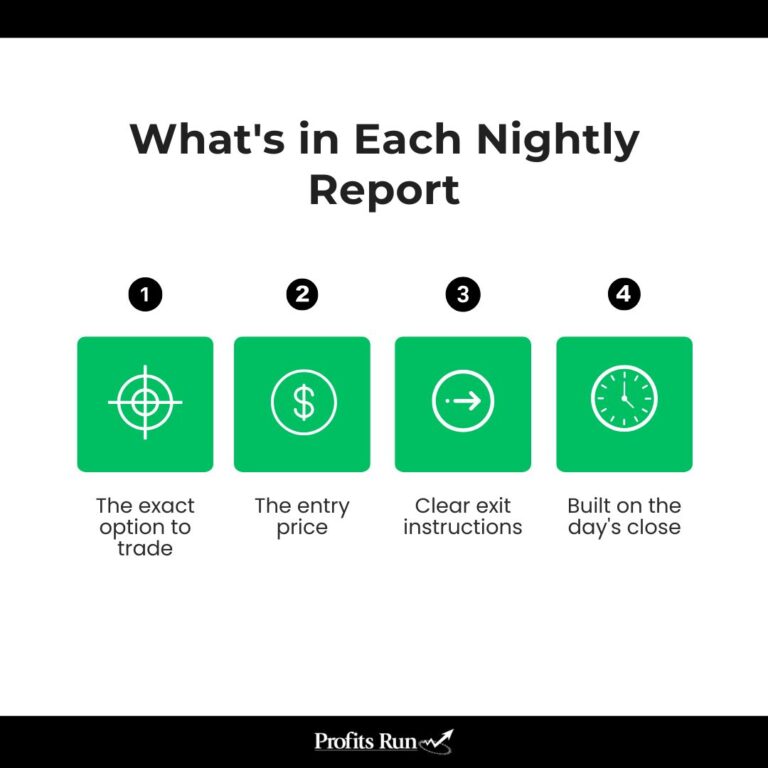
Every report is written to be acted on, not interpreted. For each trade you’ll see the specific option to buy or sell, the entry price, and the exit instructions so there’s no guesswork about what to do.
That clarity is the whole point. A new member should be able to open the email, read a trade, and place the order without needing a finance degree.
We also keep the trade count realistic. Some nights there are several new setups, some nights there are none, and a quiet night is not a problem. Patience is part of the system, not a flaw in it.
When the report hits your inbox
The report goes out in the evening after the market has closed and the day’s data is final. That timing is deliberate, because it gives you the whole night to act on it.
You can sit down after dinner, review the trades in a few minutes, and place your orders before you go to bed. If you’d rather handle it in the morning, you can place your orders before the next day’s open instead.
Either way, you decide on your own schedule, not the market’s. That single shift is what makes this approach work for people with jobs, families, and lives outside of trading.
What a Typical Evening Looks Like
Let me walk you through what following the alerts actually feels like on a normal weeknight, because I think it surprises people how simple it is.
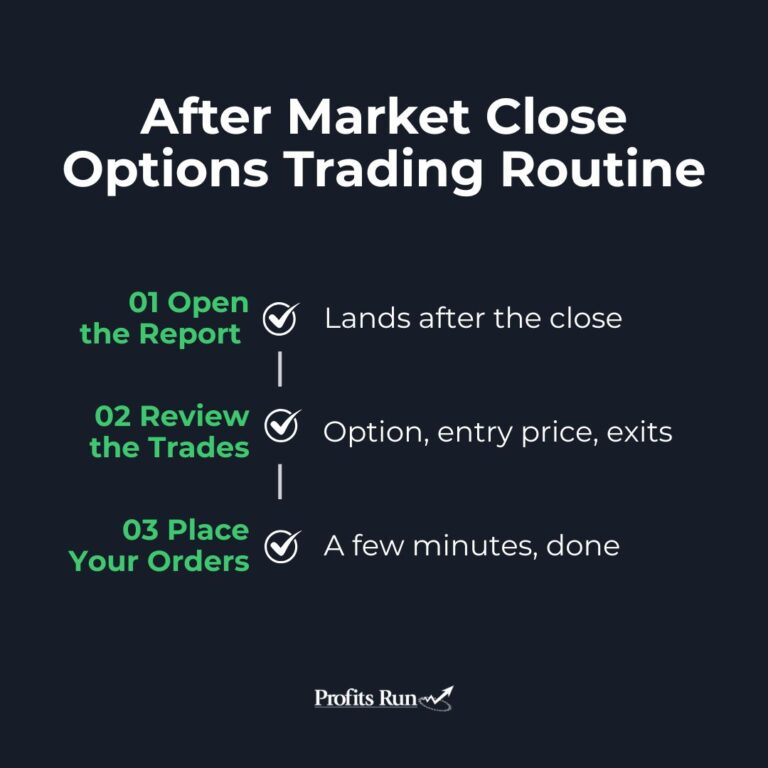
The market closes and you go about your evening. Dinner, family, whatever your night looks like. At some point the nightly trade report lands in your inbox.
You sit down with your phone or laptop and open it. If there are new trades, each one tells you the exact option to buy or sell, the entry price, and the exit instructions. You log into your broker, place the orders just as the report lays them out, and you’re done.
That whole routine is usually a few minutes. There’s no chart to read, no indicator to interpret, no agonizing over whether the setup is real. The thinking is already done, so your job is execution and discipline.
What if you miss a night?
Life happens, and sometimes you won’t get to the report until the next morning. That’s fine. You can place your orders before the next day’s open instead of the night before, and the trade still works the same way.
If you’re going to be away for a few days, the honest move is to simply not enter new trades during that window and to manage any open positions according to their exit instructions. You’re never forced to trade, and skipping a day or a setup will not break the approach. Patience and selectivity are part of how disciplined traders protect their accounts.
Can You Even Place Options Orders After the Market Closes?
This is the question I get most often, and it’s a fair one. If the market is closed, how do you act on a nightly alert?
Here’s how it works in practice. You’re placing your orders during after-hours or before the next morning’s open, so they’re ready to go when the market reopens. You’re not trying to force a fill at midnight. You’re setting up your trades in advance so the next session does the work for you.
Your broker holds the orders you place and handles them when the market is open again. So the few minutes you spend in the evening are about preparation, not live execution. By the time you’d normally be at your desk panicking over a chart, your trades are already placed and waiting.
For a lot of members, this is the part that finally makes options feel manageable. You never have to be at your screen during trading hours to follow the alerts. A few minutes each evening is the entire time commitment.
Why After-Hours Timing Lowers the Pressure, Not the Discipline
I never want anyone to read “a few minutes a night” and think this is easy money. It isn’t, and I’d be doing you a disservice to pretend otherwise.
The after-close rhythm removes the emotional pressure of the trading day. It does not remove the need for discipline, and the most important discipline in all of trading is how you size your trades.
Position sizing is what keeps you in the game
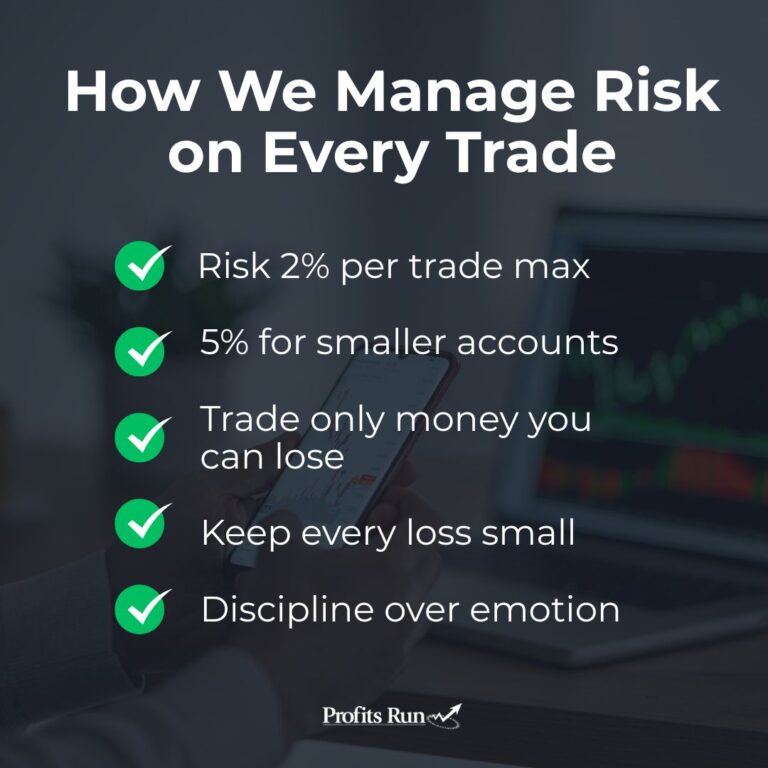
At Profits Run, we teach traders to risk no more than 2% of your account on any single trade, and 5% for smaller accounts. We also believe you should only trade with money you can afford to lose.
Let me put that in real numbers. Say you have a $10,000 account and you follow the 2% rule. That means your maximum risk on any one trade is about $200.
This example is hypothetical and only meant to show the math, not to promise any result. But the lesson is real: if you size every trade so a loss is small and survivable, no single trade can wreck you. That’s how traders last for years instead of blowing up in a few months.
For smaller accounts, we allow a little more room with the 5% guideline. On a $3,000 account, 5% works out to about $150 of risk per trade. The percentage is higher, but the dollar amount stays small enough that one loss is never the end of your trading. The goal at every account size is the same: keep losses small enough that you live to trade another day.
Why this isn't day trading
Green Light Alerts is built to capture momentum moves, not to scalp tiny intraday wiggles. The average hold time is around 8 sessions, so you’re holding positions for days, not minutes.
That slower pace fits the nightly rhythm perfectly. You’re not flipping in and out of trades all day. You enter when the report tells you to, you let the move play out over a week or so, and you exit when the instructions say to.
For most everyday traders, a method you can follow in a few calm minutes a night is far more realistic than one that demands you stare at a screen for six hours.
Is Trading Options After Market Close Riskier?
A lot of people assume that acting on alerts after hours must be more dangerous than trading live. In my experience, the opposite is usually true.
The market risk of an options trade comes from the position itself, your strike, your expiration, and most of all your position size. The clock time when you made the decision doesn’t change the risk of the trade. A well-sized trade decided at 7 p.m. carries the same market risk as the same trade decided at noon.
What does change is your behavior. Decisions made during a fast-moving session tend to be emotional, rushed, and reactive. Decisions made after the close, with a finished chart in front of you, tend to be calmer and more rule-based.
So while no approach is risk-free, the after-close timing tends to reduce the emotional mistakes that cost traders the most. You still have to respect your stops and your sizing. You just get to make the call without the market screaming at you.
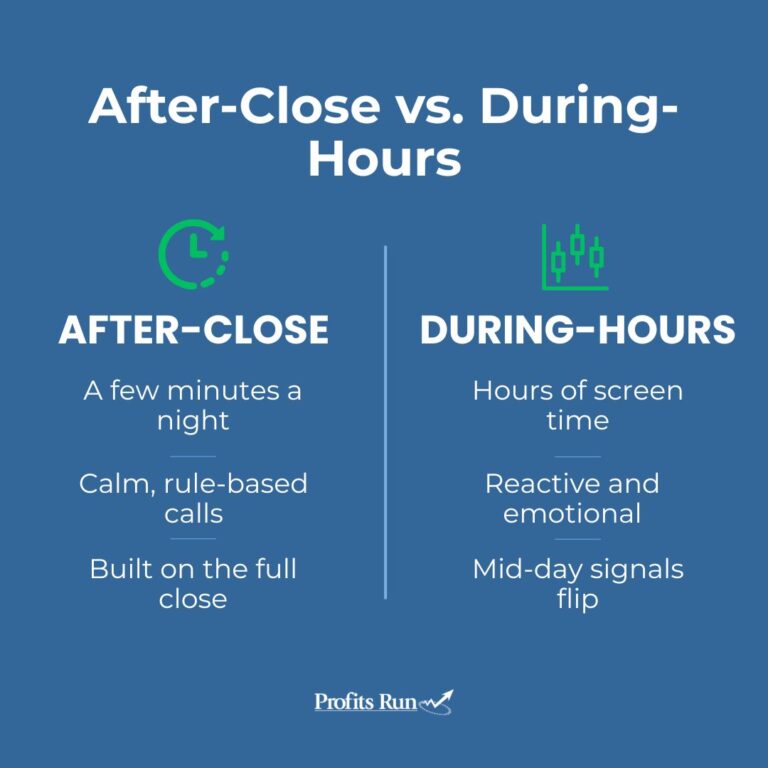
After-Close vs. During-Hours: Which Fits Your Life?
I’m not going to tell you nobody should ever trade during market hours. Plenty of skilled traders do it well. But for the regular people we work with, the nightly approach simply fits real life better.
The pattern is pretty clear. If you have a full-time job, a family, or anything else that needs you between 9:30 and 4, the nightly rhythm gives you a real way to trade options without quitting your life.
That’s exactly who we built Green Light Alerts for. Not professionals glued to a terminal, but everyday folks who want a disciplined, repeatable approach they can actually keep up with.
How Much Time and Money You Need to Get Started
Let’s talk practically about what it takes to follow this approach.
On time, the commitment is small by design. You’ll spend a few minutes each evening reviewing the nightly report and placing your orders. That’s the whole routine, and it’s the same whether you trade one position or several.
On account size, many of our options members start somewhere in the $5,000 to $10,000 range. You can begin with less, but a slightly larger account gives you more room to size trades properly and follow the 2% rule without your positions being too small to matter.
You don’t need prior experience either. Every Profits Run product comes with step-by-step training, and our support team is available Monday through Friday, 9 a.m. to 5 p.m. EST, to help you get set up. We always recommend going through the training before you place a single real trade.
An Honest Take on Whether This Approach Is Right for You
I believe in this approach because I trade this way myself, and I’ve watched it help thousands of everyday traders trade with more clarity and less stress. But I’m not going to pretend it’s magic.
There is no guaranteed rate of return, and no approach can guarantee you against losses. All trading involves risk, past performance never guarantees future results, and any performance figures you see in our materials are hypothetical. Anyone who promises you sure profits is not someone you should be listening to.
What I can promise is a method that’s realistic, repeatable, and built around protecting your capital first. You make calm decisions after the close, you size every trade so a loss is survivable, and you let a slower hold time do the heavy lifting.
If that sounds like a saner way to trade options than living in front of a screen, Green Light Alerts was built for you. And because every Profits Run program is backed by our 90-day money-back guarantee, you can try it, go through the training, and decide for yourself with your downside protected. If it isn’t a fit within 90 days, you get a full refund, and no trading records are required.
Ready to trade options on your own schedule instead of the market’s?
Get the nightly approach we use to help everyday traders act with discipline, clarity, and proper risk management.