

Are Trading Courses Worth It? A 50-Year Trader's Honest Assessment
Here’s the honest answer: trading courses can be worth every penny if they meet specific criteria and if you’re ready to put in the work.
The best education can save you thousands of dollars in preventable losses while cutting years off your learning curve. But the wrong course, or even a good course at the wrong time, can set you back both financially and emotionally.
I’m Bill Poulos, and I’ve been trading for over 50 years. I started back in 1974 when traders still called brokers on the phone to place orders. I’ve seen every market cycle, every trading fad, and every educational approach imaginable.
In 2001, my son Greg and I founded Profits Run from our kitchen table, and over the past 25 years, we’ve helped over 100,000 everyday traders learn to trade more consistently.
In this article, I’m going to give you the unvarnished truth about trading courses based on decades of real-world experience. You’ll learn when courses are worth it, when they’re not, how to spot scams, what quality education should include, and how to decide if you’re ready to invest in your trading education.
Tired of sifting through trading advice that doesn’t fit your life?
Discover how to trade smart with strategies designed for busy people who can’t watch screens all day.
Is Investing in a Trading Course Worth It?
The short answer is yes, trading courses can be worth it, but only if two critical variables align: the quality of the course and your readiness as a student.
You can have the best course in the world, but if you’re looking for a get-rich-quick scheme or you’re not willing to practice, you’ll waste your money.
On the flip side, even the most motivated student will struggle with a course that’s more marketing than education.
Let me share something I learned early in building Profits Run. Back when my son Greg and I were just getting started, we attended a business seminar where the speaker talked about two paths to success.
You can take the fast track, where you invest in education and mentorship to avoid costly mistakes. Or you can take the slow path, where you learn everything through trial and error, paying for your education with losses instead of course fees.
Most traders choose the slow path without realizing it. They jump into the markets with a brokerage account and some YouTube videos, lose money, get frustrated, and either quit or finally seek proper education after they’ve already blown through their initial capital.
The real question isn’t whether courses are worth it. It’s whether the money you’ll save by avoiding preventable mistakes exceeds the cost of quality education.
In my experience, the answer is usually yes, but with important caveats we’ll get into.
The Sobering Statistics About Trading Success
Before we go further, let’s be honest about what you’re up against. Studies consistently show that only 1% to 13% of independent traders are profitable over the long term. That’s not a typo. The vast majority of people who try trading end up losing money.
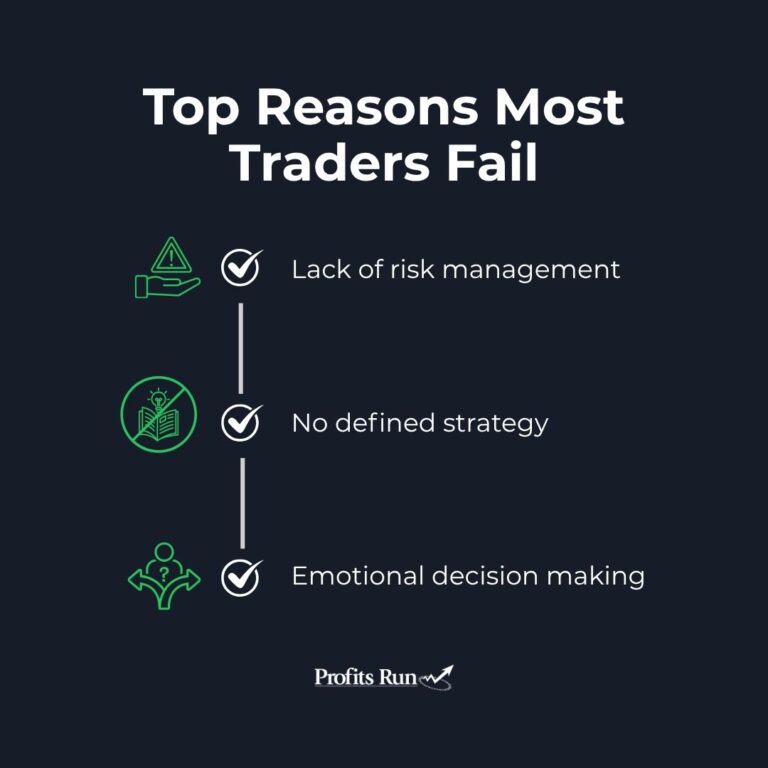
Why do most traders fail? After watching thousands of students over the years, I’ve learned what makes or breaks a trader. Here are the top reasons why most traders fail:
- Lack of risk management: Traders risk too much on single trades, don’t use stop losses properly, and let emotions drive position sizing. Over 80% of traders quit due to poor risk management and emotions.
- No defined strategy: Many traders chase tips, follow random signals, or try to predict market moves without any systematic approach. Having trading strategies for consistent profits gives you a repeatable process instead of relying on emotion or guesswork.
- Emotional decision making: Fear and greed cause traders to exit winners too early and hold losers too long. Add in unrealistic expectations, where people think they’ll turn $500 into $50,000 in a few months, and you have a recipe for disappointment.
The real question is whether proper education can improve these odds. You need the right education that addresses these specific failure points, not just generic information about charts and indicators.
Quality courses tackle risk management first, before even discussing strategies. They provide systematic approaches with clear rules, not just vague tips.
They set realistic expectations from day one. And they help you develop the psychological discipline to stick to your plan when emotions are running high.
When Trading Courses Are Worth It
Trading courses aren’t one-size-fits-all. They’re particularly valuable in specific situations where formal education addresses gaps that self-learning can’t fill. Let me break down when investing in a course makes the most sense.
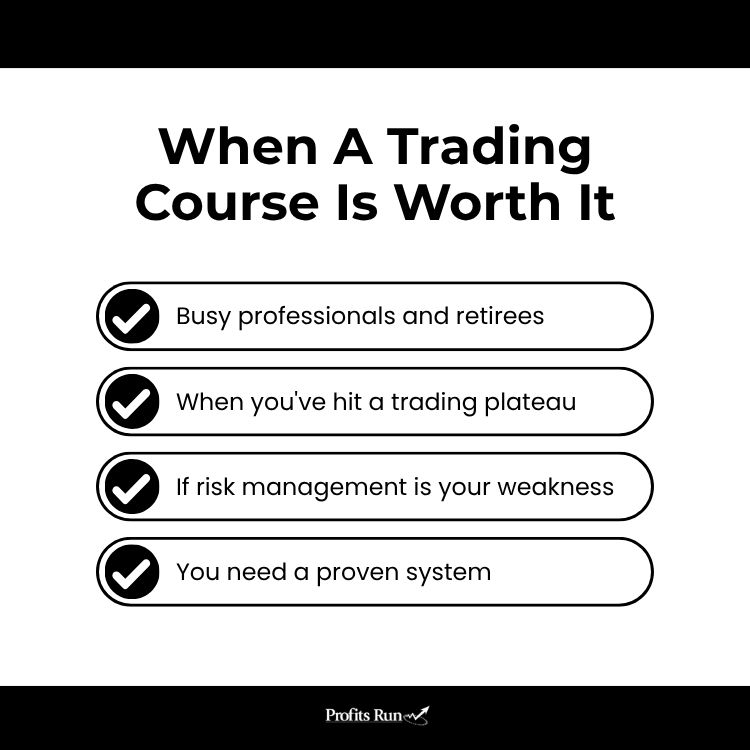
Trading Courses are Great For Busy Professionals and Retirees
Not everyone can watch screens all day, and that’s where many trading courses fail their students. Most trading education focuses on day trading, requiring you to be glued to your computer during market hours.
That’s simply not realistic for people with full-time jobs, family responsibilities, or anyone who values their time.
At Profits Run, we specialize in end-of-day swing trading strategies that require just 10 to 15 minutes per day. You analyze the markets after the close, set your orders, and let them work while you’re living your life.
This approach works particularly well for professionals who can check in during lunch or evenings, and for retirees who want to trade but don’t want it to become a full-time job.
Here’s why this matters: the strategies that work best for end-of-day swing trading are fundamentally different from day trading approaches. You can’t just scale up day trading tactics to longer timeframes. The risk management, position sizing, entry timing, and exit strategies all require different thinking.
This type of education is dramatically underrepresented in free YouTube content because it’s not as exciting as watching someone make fast trades all day. But for most people, it’s actually the more practical and profitable approach.
Trading Courses are a Good Investment When You've Hit a Trading Plateau
Self-taught traders often hit a ceiling they can’t break through on their own. Maybe you’re profitable some months but give back gains in others.
Or you find yourself making the same mistakes repeatedly despite knowing better. You’ve read the books, watched the videos, but something’s still not clicking.
This is where outside perspective becomes invaluable. When you’re deep in your own trading, you develop blind spots that only an experienced educator can see. It’s like trying to diagnose your own golf swing, you can feel something’s off but can’t pinpoint the specific problem.
A quality course provides that systematic review of your approach. We’ve had students who were close to profitability but were making subtle mistakes in position sizing or exit timing. With some guidance, they went from break-even to consistently profitable within a few months.
The key is finding education that offers personalized feedback, not just generic videos. Look for courses with coaching elements, community support, or trade review sessions where instructors can spot your specific issues.
Trading Courses Can Help When Risk Management Is Your Weakness
If you’re taking losses that wipe out weeks of gains, if you’re not sure how much to risk per trade, or if you find yourself holding losing positions too long hoping they’ll turn around, you need formal education on risk management. This is non-negotiable if you want to survive in trading long enough to become profitable.
My core philosophy has always been “cut your losses, let your profits run.” Sounds simple, right? But most traders do the exact opposite, they cut winners too early and let losers run, hoping to break even. Proper trading education makes risk management habitual, not optional.
Here’s what quality risk management education covers. You learn to size positions based on your account size and risk tolerance, not arbitrary numbers.
You understand how to set stop losses based on market structure, not arbitrary percentages. You develop the discipline to take the loss when your stop is hit, no matter how convinced you are the trade will turn around.
At Profits Run, we teach specific position sizing rules and stop loss strategies that have protected traders through bull markets, bear markets, and everything in between.
Risk management isn’t exciting, but it’s the difference between being around to trade next year and blowing up your account.
Trading Courses Provide a Proven System
There’s a massive difference between trading tips and systematic approaches. Tips are random ideas that might work sometimes. Systems are rule-based strategies tested across different market conditions, with clear entry criteria, exit rules, and risk parameters.
Courses are worth it when they provide complete trading systems, not just scattered information. A real system tells you exactly what to look for, when to enter, where to place your stop, how to size your position, and when to exit. No guessing, no second-guessing.
I developed my strategies over 50 years of actual trading through multiple market cycles. These aren’t theories or backtested ideas that look good on paper.
They’re approaches that have worked in real accounts with real money through bull markets in the 80s and 90s, the dot-com crash, the 2008 financial crisis, the 2020 pandemic crash, and everything in between.
The value of a proven system is that you’re not starting from scratch. You’re benefiting from decades of refinement and market testing.
That doesn’t mean you’ll automatically be profitable, you still need to learn and practice. But you’re building on a foundation that’s already proven to work instead of trying to invent everything yourself.
When Trading Courses Are Not Worth It
Just as important as knowing when courses are valuable is understanding when they’re a waste of money. Let’s be brutally honest about situations where even the best education won’t help.
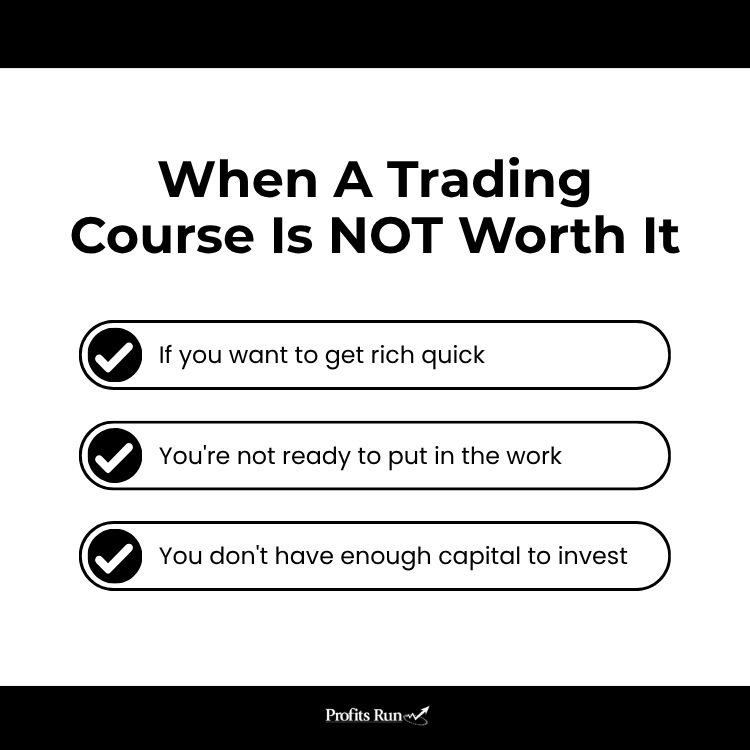
Trading Courses are Not a Good Fit If You're Looking to Get Rich Quick
No legitimate course can guarantee specific returns, and anyone who promises them is lying to you. If you’re hoping a course will turn your $1,000 account into $100,000 in six months, save your money. That’s not how trading works, no matter how good the education.
Here’s the reality check: professional traders at hedge funds and prop trading firms, with teams of analysts and millions in capital, are happy with 15% to 30% annual returns. If billion-dollar firms aren’t promising 10,000% gains, why would you expect it from a course?
The difference between income potential and guaranteed income is critical. Quality education increases your potential by teaching you skills and strategies. But your actual results depend on your dedication, practice, market conditions, capital size, and honestly, some luck.
At Profits Run, we focus on realistic, consistent results. We’d rather help you make repeatable 5% to 10% gains dozens of times per year than chase moonshots hoping for a 1,000% winner. Those moonshots sound exciting but they’re also how most traders blow up their accounts.
Trading Courses Aren’t Right You If You're Not Ready to Put in the Work
Trading is a skill, like playing an instrument or speaking a new language. You can’t just watch a few videos and expect to be proficient. It requires study, practice, review, and more practice.
Most quality courses require a minimum commitment of one to two hours per day for learning and practice. If you’re not willing or able to make that commitment, you’re wasting your money. A course can’t make you profitable if you’re not doing the work.
I’ve seen students pay for courses and barely touch the material. Then they complain that trading doesn’t work. That’s like buying a gym membership, never going, and then wondering why you didn’t lose weight.
Paper trading, where you practice with simulated money, is crucial before risking real capital. Quality courses emphasize this, but some students skip it because they’re impatient to start making money. Those are usually the same students who lose money the fastest.
Trading Courses Aren’t Worth it If You Don't Have Capital to Protect
If you’re starting with $100 and hoping to trade your way to thousands, a course isn’t your biggest problem. The harsh truth is that small account sizes make consistent profitability extremely difficult, regardless of your skill level.
Transaction costs, minimum position sizes, and the mathematics of compounding all work against very small accounts. Most professional educators recommend starting with at least $2,000 to $5,000 to have realistic chances of building an account through trading alone.
That doesn’t mean you can’t learn to trade with a small account. But be honest about your goals. Are you trying to learn skills that will serve you when you have more capital? Or are you hoping to trade your way out of a financial hole?
The timing matters. Rushing to make money before you’re ready leads to losing money. Better to save up while paper trading and learning than to blow through your initial capital making preventable mistakes.
How to Spot a Trading Course Scam (5 Red Flags)
After decades in this industry, I have seen every scam imaginable. Here are the red flags that should send you running in the other direction.
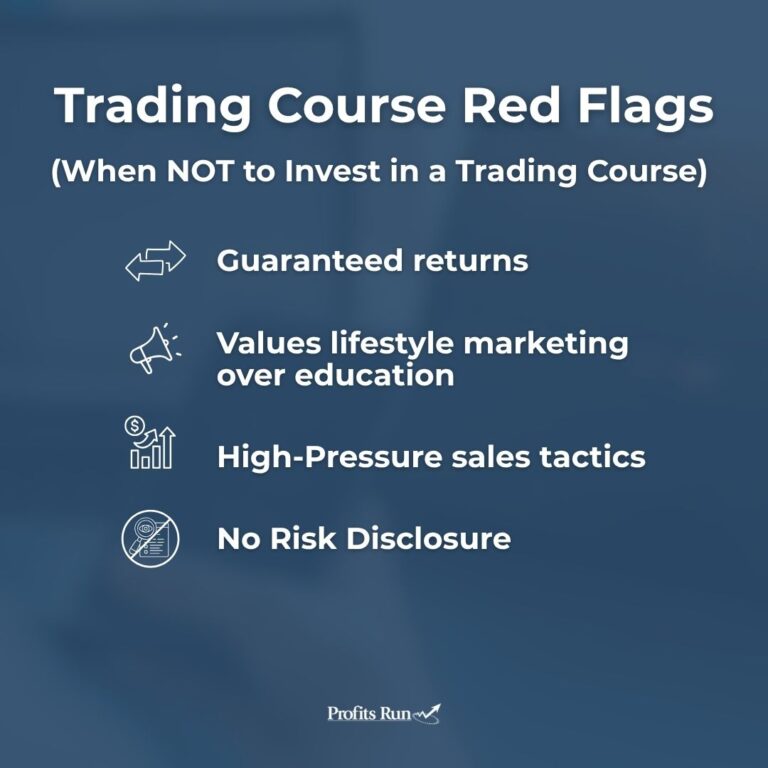
Red Flag #1: Guaranteed Returns
Any course promising guaranteed profits or specific return percentages is either lying or breaking the law. The SEC and CFTC are very clear about this, no legitimate financial educator can guarantee trading results.
Watch for language like “guaranteed 10% monthly returns” or “proven 90% win rate.” These are mathematically impossible to guarantee across all students and market conditions.
Real trading involves risk, and anyone telling you otherwise is setting you up for disappointment or worse.
Even the best traders have losing trades. With 50 years of experience, I still have losing trades.
The goal isn’t to win every trade. It’s to win more than you lose and to keep losses small while letting winners run.
If you want help evaluating whether a program is legitimate, this guide on choosing the best online trading course walks through the exact criteria smart traders use.
Red Flag #2: Lifestyle Marketing Over Education
When you see more Lamborghinis, mansions, and private jets than actual trading content, be skeptical. This is a huge tell. The FTC has taken action against course promoters who touted lavish lifestyles with luxury cars, travel, and mansions to lure students.
Legitimate educators focus on their trading results and their students’ success. Scammers focus on lifestyle marketing because it’s easier than proving they can actually trade.
Ask yourself a critical question: does this person make money from trading or from selling courses? If their business model is built on recruiting students rather than trading profits, that’s a problem.
At Profits Run, our focus has always been on education and helping regular people become more consistent traders. The goal is financial stability and supplemental income, not Instagram-worthy fake wealth.
Red Flag #3: No Risk Disclosure
Trading involves substantial risk, and legitimate courses acknowledge this upfront. If a course website or sales page doesn’t mention that you can lose money, that’s not just a red flag, it’s likely a legal violation.
Real educators follow the principle: hope for the best, prepare for the worst. We teach strategies designed to be profitable, but we’re explicit about the risks involved. Every student should understand before starting that trading isn’t guaranteed income and that they could lose their capital.
Scammers skip risk disclosure because it undermines their “easy money” marketing. They want you focused on potential gains, not potential losses. That’s the opposite of responsible education.
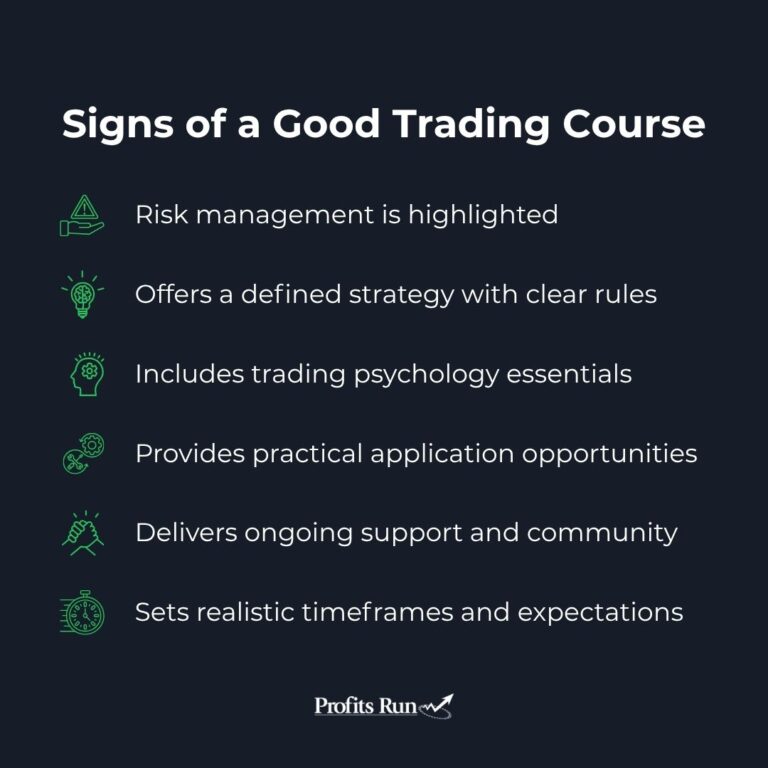
What Quality Trading Education Should Include
Now that we’ve covered red flags, let’s talk about what separates legitimate, valuable education from everything else
Risk Management First
Quality courses start with risk management, not strategies for finding winning trades. This might seem backwards, after all, isn’t the goal to find good trades?
But here’s the truth: proper risk management keeps you in the game long enough to profit from good trades.
Position sizing is the foundation. You should learn exactly how much of your account to risk on any single trade based on your risk tolerance and account size.
Stop-loss discipline comes next. A stop loss is your predetermined exit point for a losing trade. The course should teach you how to set stops based on market structure, not arbitrary percentages. More importantly, it should emphasize the discipline to actually take the loss when your stop is hit.
Capital preservation is the overarching goal. I always say, “the first rule of trading is don’t lose money. The second rule is to remember the first rule.” It sounds simple, but most trading education focuses on making money while glossing over not losing it.
A Defined Strategy with Clear Rules
Quality education provides systematic approaches, not just tips or general market commentary. A real strategy has specific entry criteria, not vague ideas like “buy when it looks good.”
It has defined exit rules for both profits and losses. It has clear position sizing guidelines. It works across different market conditions, not just bull markets.
At Profits Run, our end-of-day swing trading strategies tell you exactly what patterns to look for, what indicators to use, when to enter positions, where to place stops, and how to manage exits. No guessing, no subjective interpretation, just clear rules you can follow.
The course should also explain why the strategy works, not just what to do. Understanding the logic behind a strategy helps you adapt it to changing markets and recognize when conditions favor trading versus when it’s better to wait.
Market-tested methods matter. Anyone can create a strategy that looks good in hindsight or on paper. The real question is whether it’s been traded successfully with real money across multiple market cycles.
New traders often do better when they start with one simple, proven framework. This overview of the best trading strategy for beginners is a good example of the type of clarity a quality course should provide.
Trading Psychology Essentials
Mental discipline separates winning traders from losing ones more than any technical knowledge.
Quality courses address the psychological challenges you’ll face: handling losses without going on tilt, avoiding revenge trading after a bad day, managing FOMO when you see others making money, staying patient during drawdowns.
Fear and greed are the two emotions that destroy traders. Fear causes you to exit winning trades too early or avoid taking valid trade setups.
Greed makes you risk too much, hold losers too long hoping they’ll recover, or take trades outside your strategy because you want more action.The course should teach practical techniques for managing these emotions.
At Profits Run, we emphasize rule-based trading specifically because it removes emotion from the equation. When you have clear rules, there’s no room for fear or greed to override your decisions.
Practical Application Opportunities
Theory without practice is worthless in trading. Quality courses provide ways to apply what you’re learning before risking real money.
Paper trading platforms let you practice with simulated money in real market conditions. You should be able to test strategies, make mistakes, and refine your approach without financial consequences. Any course worth its salt emphasizes extensive paper trading before going live.
Real examples and case studies show you how the strategy works in different market scenarios. I often review both winning and losing trades to illustrate proper execution and common mistakes. Learning from others’ mistakes is cheaper than making them all yourself.
Market analysis practice helps you develop the skill of scanning markets and identifying opportunities.
Ongoing Support and Community
Learning to trade isn’t a one-and-done event. Markets change, you’ll have questions, you’ll face situations not covered in the initial material. Quality courses provide ongoing support through multiple channels.
Coaching or mentorship access means you can get feedback on your specific trades and questions. This personalized guidance catches mistakes you might not see yourself and accelerates your learning dramatically.
Community forums or groups connect you with other students at similar stages. Trading can be isolating, and having a community of people working toward the same goals provides motivation and shared learning. At Profits Run, our students often help each other spot opportunities and troubleshoot challenges.
Regular updates keep the material current as markets evolve. A course created 10 years ago and never updated might have outdated information or examples. Look for evidence that the educator stays engaged with the material and updates it regularly.
Realistic Timeframes and Expectations
Quality education is honest about how long it takes to become consistently profitable. Most traders need six months to a year of dedicated learning and practice before they’re reliably profitable, and that’s with good education.
The course should set clear milestones for your learning journey. What should you master in month one versus month three versus month six? Without this roadmap, students often get discouraged because they don’t know if their progress is normal.
Transparency about win rates and risk-reward ratios helps you understand what success actually looks like. If a strategy wins 60% of the time with a 2:1 risk-reward ratio, that’s very different from 40% win rate with a 3:1 ratio. Both can be profitable, but your experience trading them will be completely different.
At Profits Run, we’re explicit that becoming a skilled trader takes time and effort. We’re here to guide you and provide the strategies, but we can’t make you profitable overnight. Anyone promising faster results is either lying or setting you up for failure.
A Checklist for Evaluating Trading Courses
Before you invest in any trading course, run it through this checklist. These questions help you separate legitimate education from expensive disappointments.
Is there a clear methodology or just vague “secrets”? Real courses teach systematic approaches with defined rules. Scams promise secret techniques or insider methods without explaining actual strategies.
Does the course match your available time and lifestyle? If you have a full-time job, a day trading course requiring constant screen time won’t work for you. Make sure the approach fits your reality.
Is risk management emphasized before profit strategies? This is crucial. If the course leads with “how to find 500% winners” instead of “how to protect your capital,” that’s a backwards priority.
Are there realistic expectations set upfront? Legitimate courses acknowledge that trading involves risk, takes time to learn, and doesn’t guarantee income. Overpromising on results is a major red flag. This guide on how to earn money from trading the safe, methodical way is aligned with what real traders actually do.
Is there ongoing support after the initial training? One-off video courses with no follow-up leave you stranded when you have questions. Look for coaching, community access, or update privileges.
Can you find independent reviews and testimonials? Don’t rely solely on testimonials on the course website. Search for reviews on forums, social media, or sites like Trustpilot. What are actual students saying?
The Free Alternative and Why It Often Fails
You might be wondering, “Can’t I just learn from YouTube and trading forums for free?” Yes and no. Free resources are abundant, but they come with hidden costs that often exceed the price of quality education.
The YouTube and Reddit approach gives you access to thousands of hours of trading content for free. You can learn basic concepts, terminology, chart patterns, indicator usage, and general market knowledge.
For absolute beginners, this is actually a good starting point to see if trading interests you before investing money.
But here’s where free learning typically breaks down. The information is fragmented and often contradictory. One trader swears by moving averages while another claims they’re useless.
Someone says to risk 5% per trade while another preaches 1%. You end up with puzzle pieces from different puzzles that don’t fit together into a coherent strategy.
The hidden cost is time spent filtering good information from bad, and mistakes made during extended trial-and-error.
How do you know which YouTube trader to trust? How many losing trades will you take while figuring out what works? What’s the dollar cost of those losses?
Free content also lacks personalized feedback.
You can’t ask the YouTube video why your trade didn’t work or get help troubleshooting your specific challenges. You’re on your own trying to apply generic information to your specific situation.
Another problem is that free content creators often make money from affiliate deals with brokers or by eventually selling you something.
Their incentives might not align with your best interests. The content is free because you’re the product, being funneled toward broker sign-ups or eventual course purchases.
When free learning works best: You’re learning fundamental concepts and terminology. You’re figuring out if trading interests you before investing money. You’re supplementing paid education with additional perspectives.
When free learning typically fails: You need a systematic, rule-based approach to actually trade profitably. You want to avoid years of trial-and-error losses. You need personalized guidance to overcome your specific challenges. You want strategies tested across multiple market cycles, not just recent bull market success.
The middle ground is books. Quality trading books from established traders can provide systematic knowledge at low cost. I always recommend starting with good books before committing to courses.
They’re cheap, let you learn at your own pace, and the best ones are written by people with genuine expertise.
But books, like free content, lack the personalized feedback and ongoing support that accelerate learning. They give you knowledge but don’t ensure you apply it correctly.
Making Your Decision: Are Trading Courses Worth It for You?
We’ve covered a lot of ground, so let’s bring it together. Trading courses can absolutely be worth your investment, but only if specific conditions align.
The course quality matters. It should provide risk management fundamentals, systematic strategies with clear rules, trading psychology guidance, practical application opportunities, ongoing support, and realistic expectations. It should be taught by someone with verifiable trading experience and a track record of helping students.
Your readiness matters equally. You need realistic expectations, not get-rich-quick hopes. You need willingness to put in the work, typically one to two hours daily for several months. You need sufficient capital to trade meaningfully once you’re ready to go live, usually at least a few thousand dollars.
The fit with your lifestyle matters too. If you’re a busy professional, day trading courses requiring constant screen time won’t work. If you can only dedicate evenings to trading, you need end-of-day strategies like what we teach at Profits Run. Match the course to your reality, not wishful thinking about how much time you’ll have.
Quality trading education is buying a seat at the table with experienced traders who’ve already made the mistakes you’re about to make. You’re paying to compress years of trial-and-error into months of guided learning.
That’s valuable if you’re serious about trading, but it’s wasted money if you’re just curious or hoping for easy money.
The real investment isn’t the course price, it’s your time and effort. A $200 course you actually complete and apply is far more valuable than a $2,000 course you never finish. The best education in the world can’t help you if you don’t use it.
At Profits Run, we’ve helped over 40,000 everyday traders learn to trade more consistently using end-of-day swing trading strategies.
Our students include doctors, teachers, retirees, small business owners, and anyone else who can’t watch screens all day but wants to participate in the markets intelligently.
We focus on risk management first, systematic rule-based strategies second, and realistic expectations always.
We’re not promising you’ll get rich. We’re promising you’ll learn approaches that have worked for 50 years across every imaginable market condition, taught by someone who’s actually been trading through all of them.
Whether you decide to learn from Profits Run or another quality source, make sure it meets the criteria we’ve discussed.
Your trading education is an investment in a skill that can serve you for decades. Choose wisely, commit fully, and give yourself time to develop competency before expecting profits.
Tired of sifting through trading advice that doesn’t fit your life?
Discover how to trade smart with strategies designed for busy people who can’t watch screens all day.