
Best Options Alert Service (How to Find One That Actually Fits Your Life)
The best options alert service is the one that matches your trading style, your schedule, and your risk tolerance.
For most people with a full-time job, family, or a life outside the markets, that means an end-of-day swing trading alert service that gives you clear entries, exits, and built-in risk management. One where you can review trades in minutes after the market closes instead of watching a screen all day.
No alert service will turn you into a profitable trader overnight. Alerts are a tool, and like any tool, they only work when you understand how to use them. The traders who get the most from alert services are the ones who also understand the “why” behind each trade, not just the “what.”
In this guide, we are going to break down what actually separates a good options alert service from one that wastes your money. You will learn how to evaluate any service on your own, the specific features that matter most, and why the type of alert you choose is the single most important decision you will make.
Want to see what end-of-day options trading alerts look like in practice?
Get specific trade recommendations with entry, exit, and risk management built right in.
Why Most "Best Options Alert Service" Lists Are Misleading
If you have ever searched for the best options alert service, you have probably noticed something. Almost every result looks the same. A numbered list of services, each with a short description and a button to sign up.
What you might not realize is that many of those lists are built around affiliate partnerships. The service ranked #1 is often the one that pays the highest commission to the person writing the article, not the one that performs the best for traders.
We have even seen companies rank themselves as the #1 pick on their own blog. When the reviewer and the product are the same company, that is not an unbiased recommendation.
Here is something else those lists rarely tell you. Many of the performance numbers you see, the “150% annual return” or “91% win rate” claims, are based on backtested data, not live trading results.
Backtesting means running a strategy against historical price data to see how it would have performed. That is a useful tool, but it is not the same thing as actually trading real money in real market conditions.
This is not to say every alert service is a scam. Plenty of them are run by experienced traders doing solid work. But the way they are marketed and ranked often obscures the information that actually matters to you as a trader.
The question is not “which service is ranked #1 on the most websites?” The question is “which type of alert service fits my life, my goals, and my risk tolerance?”
That is what the rest of this guide will help you figure out.
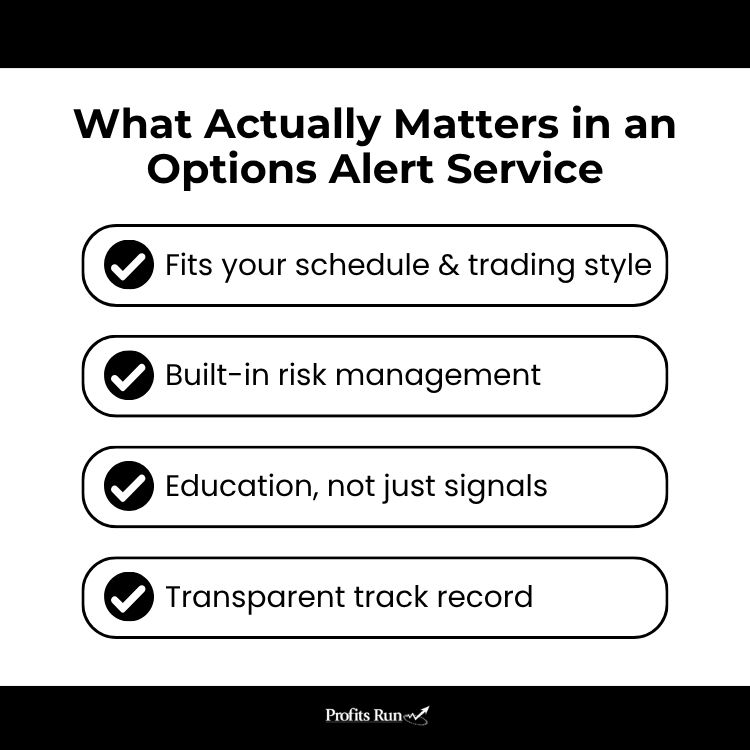
What Actually Matters When Choosing an Options Alert Service
Before you compare prices or read reviews, there are five things that should guide your decision. These are the factors that will determine whether an alert service helps you grow as a trader or just drains your bank account.
Trading Style: Day Trading vs. Swing Trading vs. Income Strategies
This is the most important decision, and most comparison articles skip right past it.
Day trading alerts require you to be at your computer during market hours. If you cannot act on a signal within minutes, sometimes seconds, the opportunity is gone. For someone with a 9-to-5 job, day trading alerts are almost impossible to use consistently.
Swing trading alerts work on a completely different timeline. Trades are held for days to weeks, and the analysis typically happens after the market closes. You review the alert in the evening, place your orders, and go about your day the next morning.
Income strategies like covered calls and credit spreads are a third category entirely. These focus on collecting premiums from selling options, and they require a different set of knowledge and account permissions.
Most listicles lump all three together in the same ranking, which is a bit like comparing a pickup truck, a sports car, and a minivan and declaring one of them “the best vehicle.” The right answer depends on what you need it for.
Alert Delivery and Timing: Intraday vs. End-of-Day
This is the factor that affects your daily life more than anything else, and almost nobody talks about it.
Intraday alerts lose value within minutes. By the time you see the notification, open your brokerage app, and place the order, the price may have already moved.
This execution gap is one of the biggest hidden problems with real-time alert services. You end up buying at a worse price than the alert suggested, which can turn a winning trade into a losing one before it even starts.
Think about what that looks like in real life. An alert comes through at 10:15 AM. You are in a meeting at work. You glance at your phone, excuse yourself to the bathroom, open your brokerage app, and try to place the order.
By 10:22 AM, the option that was priced at $2.50 in the alert is now trading at $3.10. You have already given up 24% of potential profit before the trade even begins. Multiply that across dozens of trades, and the slippage alone can eat through whatever edge the alert service claims to provide.
This is not a hypothetical problem. It is the daily reality for anyone trying to follow real-time alerts while living a normal life.
End-of-day alerts eliminate that problem entirely. The analysis happens after the market closes, the alert comes to you in the evening, and you have time to review it on your own schedule. You place your orders before the next day’s open or set conditional orders that only trigger if the stock hits a specific price.
At Profits Run, our done-for-you alert services are built around this end-of-day model. Green Light Alerts, for example, sends a nightly trade report after the close. You review it, place your orders, and the whole process takes a few minutes. No rushing. No staring at charts during lunch breaks.
For people with busy schedules, end-of-day alerts are not just more convenient. They are a strategic advantage. You are making decisions when you are calm and focused, not reacting under pressure during a volatile trading session.
Risk Management: The Feature Most Services Leave Out
Here is a question that will tell you a lot about any alert service: does it tell you when to get out if the trade goes wrong?
A surprising number of services give you entry signals but leave the exit strategy vague or undefined. They tell you what to buy and when to buy it, but they do not tell you where to set your stop loss or when to take profits. That is like giving someone directions to a destination but not telling them where to turn around if they get lost.
Every alert from a quality service should include at least three things: the entry (what to buy and at what price), the profit target (when to sell for a gain), and the stop loss (when to sell to limit your loss).
At Profits Run, risk management is built into every trade recommendation. Every alert includes defined stop losses and profit targets. And we teach a simple rule that applies to everyone: never risk more than 2% of your trading account on a single trade.
For smaller accounts, that number might stretch to 5%, but the principle is the same. No single trade should have the power to seriously damage your account.
What separates traders who last from traders who blow up their accounts is not their win rate. It is how they manage risk.
Education vs. Copy-and-Paste Signals
Some alert services send you a ticker symbol and a direction, and that is it. Buy this call. Sell this put. No explanation. No context. Just follow the signal.
That approach has a problem. When market conditions change, and they always do, you will not know what to do. If you have been blindly copying someone else’s trades for six months and then the market shifts, you have no framework for making your own decisions. You are stuck.
The best alert services teach you why a trade was selected, not just what to trade. Over time, the alerts should help you become a more skilled trader, not a more dependent one.
At Profits Run, every product comes with step-by-step training videos, quickstart guides, and trading blueprints. We want you to understand the strategy behind each alert so that you are learning while you trade. That is a big part of our philosophy. Education is not a side feature. It is the foundation.
Transparency and Track Record
A service that shows you only its wins is not being honest with you. Every trading strategy loses sometimes. That is just how markets work.
Look for services that publish both wins and losses. A service with a 55-60% win rate that also shows how its average win compares to its average loss is far more trustworthy than one claiming 90%+ win rates with no context about how those numbers were calculated.
Pay attention to whether performance claims are based on backtested or hypothetical results versus actual live trades. Both have value, but they are not the same thing, and any service that blurs the line between the two is waving a red flag.
No legitimate trading service can guarantee a specific return. All trading involves risk, and past performance, whether hypothetical or live, does not guarantee future results.
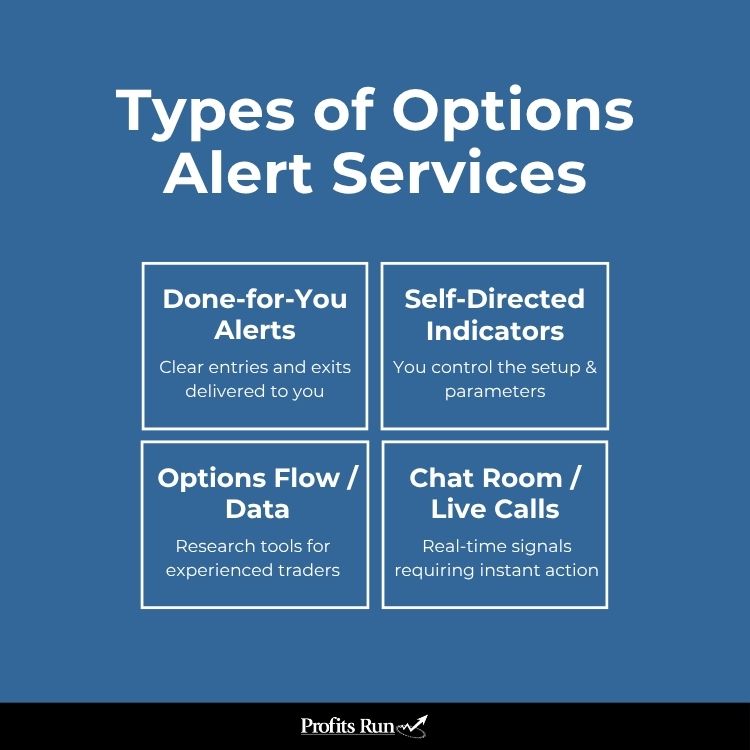
The Different Types of Options Alert Services
Not all alert services work the same way, and understanding the differences is one of the most important steps you can take before spending a dollar on any of them.
Done-for-You Alert Services
These are the most hands-off option. You receive specific trade recommendations with clear entry and exit instructions. Little to no chart analysis is required on your part. You just follow the alerts.
Done-for-you alert services are ideal for beginners or traders who want a straightforward, low-time-commitment approach.
At Profits Run, Green Light Alerts and Wave Catcher Alert both fall into this category. Green Light Alerts delivers a nightly trade report after market close with specific options to buy or sell, including entry prices and exit instructions. Wave Catcher Alert sends email alerts when trade setups are identified, complete with contingent orders, stop losses, and profit targets.
Both services involve only buying options (calls and puts), which is the simplest form of options trading. No complex spread strategies. No selling naked options. Just defined-risk trades with clear rules.
Self-Directed Indicator-Based Alerts
With this approach, you set up an indicator on a charting platform and it notifies you when a trading setup appears. You have more control over your trades, but you also need to manage them yourself.
This is a good fit for people who want to learn the mechanics of trading and eventually make their own decisions. You are still getting help finding trades, but you are also building your own skills in the process.
Profits Run products like MoneyBell and the Hot Zone Indicator work this way. They run on TradingView, a free charting platform, and they send automated alerts when new entry or exit signals appear. You can set them up on your computer and receive notifications on your phone, so you are never tied to a desk.
Options Flow and Data Services
These services track unusual options activity and institutional order flow. Tools like FlowAlgo, Unusual Whales, and Market Chameleon fall into this category.
Options flow services are research tools, not done-for-you alert services. They show you where large institutional orders are being placed, but interpreting that data requires a solid understanding of options mechanics, order types, and market structure.
For experienced traders, these tools can be valuable. For beginners, they can be overwhelming and potentially misleading.
A large options order from an institution does not always mean the stock will move in that direction. There are hedging strategies, complex positions, and other reasons behind those orders that are not obvious from the data alone.
Community and Chat Room-Based Alerts
Some services deliver alerts through Discord, Telegram, or live trading rooms. A trader or “guru” calls out trades in real time, and members try to follow along.
The appeal is obvious. You feel like you are part of a team, and there is an excitement to trading alongside other people.
The problem is that these alerts require you to be online and ready to act instantly. By the time a trade is called in a chat room and you place your order, the price may have already moved significantly.
When hundreds of people try to buy the same option at the same time, the price gets pushed up before most of them can fill their order.
This format also carries a risk of “herd mentality,” where members follow trades without questioning them because everyone else is doing the same thing. That is not a trading strategy. That is crowd behavior.
For anyone who cannot be glued to a screen during market hours, chat room-based alerts are not a realistic option.
Why End-of-Day Swing Trading Alerts Work Best for Most People
If you have read this far, a pattern should be forming. Most of the alert service problems we have discussed, execution gaps, screen time requirements, pressure to act fast, they all trace back to the same root issue: the alerts require you to trade during market hours.
End-of-day swing trading alerts solve that problem by design.
Swing trading holds positions for days to weeks, and the trade decisions happen after the market closes. You are not trying to catch a five-minute price move. You are positioning yourself to ride a trend that plays out over several days.
Here is why that matters in practical terms. When you receive an alert after the market closes, you can sit down, review the trade idea, think about whether it fits your risk tolerance and account size, and place your order calmly. There is no urgency. There is no “act now or miss it” pressure.
You are making better decisions because you are making them on your own schedule, not reacting to a flashing screen.
There is also a psychological benefit that does not get talked about enough. Day trading alerts put you in a reactive state of mind all day long. Even when you are not looking at your phone, you are thinking about it.
You are wondering if you missed something. That low-grade stress affects your focus at work, your patience at home, and your overall quality of life.
End-of-day alerts draw a clear line. During the day, you live your life. After the close, you spend a few minutes on your trading. Then you are done until tomorrow. That separation is not just convenient. It protects your mental energy for the things that matter most.
At Profits Run, our trading systems are specifically built for this approach. Our average hold time is around 15 days. We target repeatable shorter gains rather than risky moonshots.
And we keep the time commitment realistic, because most of our members have full-time jobs, families, and lives that do not revolve around the stock market.
Here is what a typical week might look like for a Green Light Alerts member. Monday through Thursday, you spend a few minutes each evening reviewing the nightly trade report. Maybe you place one or two new orders. Maybe there are no new setups that day.
On the weekends, you are completely free. No homework. No market anxiety. Just a clean routine that fits around the rest of your life.
A few minutes each evening is all it takes to review your alerts, place your orders, and move on with your night.
That is not a compromise. For most people, that is the only approach that is actually sustainable over the long term.
Red Flags to Watch for in Any Options Alert Service
Now that you know what to look for, let’s talk about what to watch out for. These are the warning signs that should make you think twice before handing over your credit card.
Promises of Guaranteed Returns or Unrealistic Win Rates
No trading strategy wins 100% of the time. If a service claims it never loses, or if it advertises a win rate that seems too good to be true, treat that as a serious warning sign.
Even a 55-60% win rate can produce strong results when combined with proper risk management. What matters is the relationship between how often you win, how much you make when you win, and how much you lose when you lose.
A service with a 60% win rate where the average win is twice the size of the average loss is far more valuable than one claiming 90% wins with no information about loss sizes. Those small losses that go unmentioned can add up fast when they hit.
Any performance claims should include context. Were they backtested or live? Over what time period? With what position sizing? The more transparent the data, the more you can trust it.
No Clear Exit Strategy or Risk Management
This is one of the biggest red flags, and it is surprisingly common.
A complete trade alert tells you at least four things: what to buy, when to buy it, your profit target, and your stop loss. If a service only tells you when to get in but gives no guidance on when to get out, they are leaving you exposed.
Getting into a trade is the easy part. Knowing when to exit, whether the trade is working or not, is where most traders struggle. An alert service that ignores this is not managing your risk. It is outsourcing the hardest part of trading back to you.
Pressure to Trade More Often Than You Should
More alerts does not mean more profits. Some services send 10 or more alerts per day to justify their subscription fee, but quantity and quality are not the same thing.
Alert fatigue is a real problem, especially for newer traders. When you are getting bombarded with signals throughout the day, it is easy to overtrade, make impulsive decisions, or start ignoring the alerts entirely because there are too many to keep up with.
The best services send fewer, higher-quality alerts and give you the context to act on them with confidence. A handful of well-researched trade ideas per week will almost always outperform a firehose of daily signals.
No Educational Component
If a service never explains why a trade was selected, ask yourself: am I learning anything, or am I just copying someone else’s homework?
Blindly following signals without understanding the reasoning is not trading. It is gambling with a middleman. And the moment that service shuts down or changes its strategy, you are left with nothing.
Services that include training alongside their alerts give you something more valuable than any single trade. They give you knowledge you can use for the rest of your trading career.
What End-of-Day Options Alerts Look Like in Practice
Theory is useful, but let’s make this concrete. Here is what it actually looks like to use end-of-day options alerts from Profits Run on a daily basis.
Green Light Alerts: A Nightly Trade Report You Can Act on in Minutes
Green Light Alerts runs the Green Light Accelerator algorithm across its universe of stocks each day after the market closes. The system identifies any new entries or exits and compiles a nightly trade report that goes out to all members by email.
Each report tells you exactly which options to buy or sell, the entry price, and the exit instructions. There is no ambiguity. You do not need to interpret charts or make judgment calls about what the alert means.
The routine looks like this. The market closes at 4:00 PM Eastern. Sometime that evening, you receive the trade report. You open it, review any new entries or exits, and place your orders in your brokerage account. The whole process takes a few minutes.
No chart analysis. No screen watching during the day. No stress about missing a signal while you are at work.
If there are no new setups on a given day, the report tells you that too. You are never left guessing.
Wave Catcher Alert: Conditional Orders That Do the Work for You
Wave Catcher Alert takes a slightly different approach. Instead of a nightly report, you receive email alerts when specific trade setups are identified.
Each alert includes a contingent order, which means your trade only triggers if the underlying stock hits a specific price level. You place the order with your broker, and if the stock reaches that price, the trade executes automatically. If it does not reach the trigger price after a few days, you receive another alert telling you to cancel the order.
The service uses monthly options, which gives you more breathing room on timing compared to weekly options. And every alert comes with built-in stop losses and profit targets. Both your entry and your exit plan are defined before you ever place the trade.
Like Green Light Alerts, Wave Catcher Alert involves only buying calls and puts. No complex spread strategies. No options selling. Just straightforward, defined-risk trades.
Weekly Profit Window: A Weekend Check-In for Weekly Income
Weekly Profit Window works on a different schedule and uses a different strategy, but the time commitment is just as manageable.
After Friday’s market close, you check the indicator for new setups. The whole review takes about 15 to 20 minutes. If there is a bull setup, you sell a bull put spread. If there is a bear setup, you sell a bear call spread. Orders are placed before Monday’s open, and the positions expire that same Friday.
These are credit spreads, which means you collect premium upfront and profit when the stock stays within a certain range. The key advantage is that your maximum gain and maximum loss are both known before you enter the trade. There are no surprises.
This strategy takes advantage of time decay working in your favor as a net options seller. It does require Level 2 options approval at your broker for vertical spreads, so it is a step up in complexity from buying calls and puts. But the weekly routine is simple and predictable.
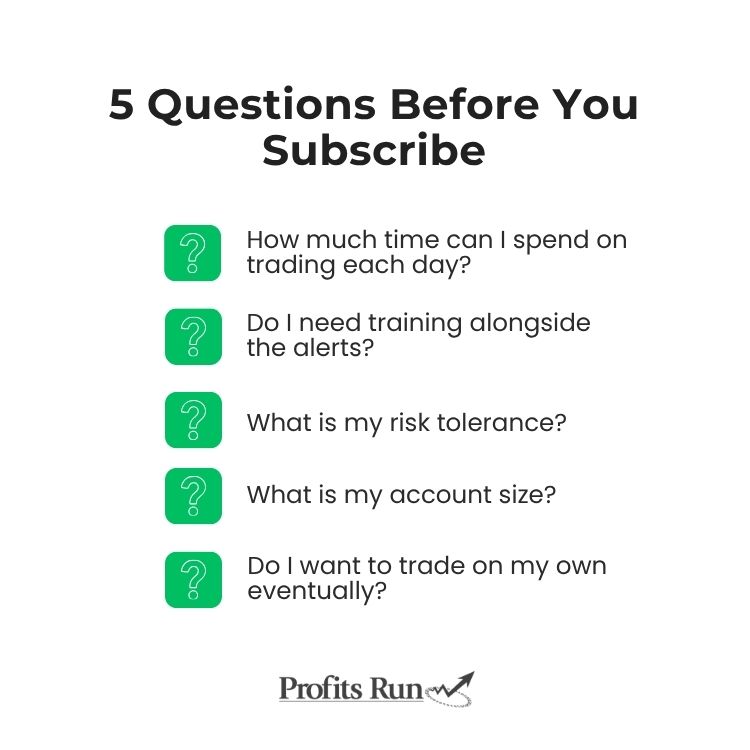
How to Choose the Right Alert Service for You
By now you have a solid understanding of what makes an alert service worth your money and what to avoid. Let’s put that knowledge to work with a practical framework.
Five Questions to Ask Before You Subscribe
How much time can I realistically spend on trading each day? Be honest with yourself here. If the answer is “a few minutes after work,” you need end-of-day alerts, not intraday signals.
If you can dedicate an hour or more during market hours, you have more options, but you should still consider whether that level of time commitment is sustainable week after week.
A lot of people start with good intentions about watching the market every day. Three weeks later, they are burned out and behind on everything else in their life.
Am I comfortable with options, or do I need training alongside the alerts? If you are newer to options, choosing a service that includes education is a safer bet. You will make better decisions when you understand the mechanics of the trades you are placing.
And if something goes wrong, you will know how to respond instead of freezing up. Even basic concepts like what a strike price means, how expiration dates affect pricing, and why time decay matters will make a real difference in how confidently you execute trades.
What is my risk tolerance? If a large drawdown would keep you up at night, look for services that include defined stop losses on every trade and emphasize position sizing. Ask yourself how much you are willing to lose on any single trade, and make sure the service aligns with that number.
Here is a simple way to think about it. If you have a $10,000 trading account and you follow the 2% rule, your maximum loss on any single trade would be $200. That means even a string of five losing trades in a row would only cost you $1,000, or 10% of your account.
That is manageable. That is survivable. And that is how you stay in the game long enough for your winning trades to accumulate.
What is my account size? Some strategies require more capital than others. For options buying (calls and puts), many traders start with $5,000 to $10,000. Credit spread strategies may require more depending on your broker’s margin requirements.
Whatever your account size, you should only trade with money you can afford to lose. That is not just a disclaimer. It is a practical rule that prevents you from making desperate, emotional decisions when a trade goes against you.
Do I want to eventually trade on my own, or am I looking for a long-term done-for-you solution? If your goal is to learn, an indicator-based service or one that includes training will serve you better in the long run. If you just want someone else to handle the analysis and tell you what to trade, a done-for-you alert service is the right fit. Either approach is valid.
The important thing is to be clear about what you want. And keep in mind that these two paths are not mutually exclusive. Many traders start with done-for-you alerts to build confidence and then gradually add self-directed indicators as their skills grow.
Finding the Right Fit
There are a lot of options alert services out there. Some are excellent. Some are mediocre. And some are designed to take your subscription fee and leave you no better off than when you started.
The difference between a service that helps you and one that wastes your time usually comes down to a few simple things. Does it match your schedule? Does it include risk management on every trade? Does it teach you something, or does it just tell you what to buy?
If you take one thing away from this guide, let it be this: the “best” alert service is not the one with the flashiest website or the longest list of claimed wins. It is the one that fits the way you actually live.
For most people, that means end-of-day swing trading alerts with clear entries, defined exits, and education built in. That is what we have spent over two decades building at Profits Run, and it is what we will keep refining for the next two decades.
Whatever you decide, take your time. Ask the hard questions. And never hand your money to a service that cannot explain how it manages your risk.
Good trading starts with good decisions, and choosing the right alert service is one of the most important decisions you will make.
Ready to see what end-of-day options trading alerts can do for your portfolio?
Every Profits Run program comes with step-by-step training and a 90-day money-back guarantee.
Frequently Asked Questions About Options Alert Services
Are Options Alert Services Worth It?
They can be, if the service matches your trading style and you treat alerts as a tool rather than a guarantee. The cost of a monthly subscription is usually small compared to what you could lose making uninformed trades on your own.
The real question to ask is whether the service teaches you anything or just creates dependency. A service that helps you grow as a trader is worth far more than one that only tells you what to buy today.
Can You Make Money with Options Trading Alerts?
Yes, but there are no guarantees. All trading involves risk, and your results will depend on position sizing, discipline, and how consistently you follow the system.
Past performance, whether hypothetical or based on live results, does not guarantee future results. Risk management is what separates traders who build wealth over time from those who blow up their accounts chasing big gains.
How Do Options Trading Alerts Work?
A system or analyst identifies a trade setup and sends you the details. That typically includes what option to buy, what price to pay, when to sell for a profit, and when to sell to limit a loss.
Alerts can be delivered by email, text, app notification, or through a chat room. Some services require immediate action during market hours, while others, like end-of-day services, give you time to review and act on your own schedule.
The best services include stop losses and profit targets with every alert, so you know your risk before you enter the trade.
What Is the Difference Between Options Alerts and Options Education?
Alerts tell you what to trade. Education teaches you why and how.
The most effective approach combines both. When you understand the strategy behind an alert, you can make better decisions about position sizing, timing, and when to stay out of the market entirely.
At Profits Run, every alert service includes training materials because we believe you should understand what you are doing with your money. Alerts are a tool. Education is what makes that tool effective.
How Much Should an Options Alert Service Cost?
Prices vary widely. Some services charge $47 to $79 per month, while others run $150 to $250 per month or more. A few offer annual plans at a discount.
The cost of the subscription is less important than the value you get from it. A $200/month service that teaches you risk management and helps you avoid one bad trade is worth more than a free chat room that costs you $2,000 in losses because you followed the crowd into a reckless position.
Be cautious about any service with a price that feels designed to create urgency rather than value. High-pressure sales tactics, countdown timers, and “today only” pricing are not signs of a confident, established service.
At Profits Run, we keep our pricing straightforward and back everything with a 90-day money-back guarantee because the product should sell itself.
Do I Need Trading Experience to Use an Options Alert Service?
Not necessarily. Done-for-you alert services are specifically designed so that you do not need to analyze charts or interpret complex data on your own. You receive clear instructions and follow them.
That said, we always recommend learning the basics before you start placing trades with real money. Even a few hours spent understanding how options work will make you more confident and less likely to panic when a trade moves against you.
At Profits Run, all of our products come with training materials built in, and our support team is available Monday through Friday if you have questions along the way.