
Options Trading Alerts Service Reviews (What Most "Review" Sites Won't Tell You)
If you’ve been searching for honest reviews of options trading alert services, you’ve probably noticed a pattern. Most “review” sites rank the services they get paid to promote, and the actual review part is pretty thin.
Some options trading alert services are worth every penny, and some are a waste of money no matter how cheap they are. The difference comes down to a few specific things that most review sites never talk about, like how the alerts are generated, whether the service is designed for your actual lifestyle, and whether you’re learning anything or just blindly following trades.
We run an alert service at Profits Run, so yes, we have a perspective here. But we’re not going to pretend ours is perfect for everyone. What we will do is show you exactly how to evaluate any alert service, including ours, so you can make a smart decision with your own money.
In this guide, you’ll learn what separates a legitimate options alert service from one that’s built on marketing hype. We’ll cover the red flags to watch for, the questions you should ask before you subscribe, and why the way a service delivers its alerts matters just as much as the alerts themselves.
Curious how our alert services actually work?
Get a behind-the-scenes look at our approach, including our 90-day money-back guarantee.
Why Most Options Trading Alert Service Reviews Are Misleading
Before we get into what makes a good alert service, we need to talk about why it’s so hard to find a straight answer online.
If you search “best options trading alert service” or “options alert service reviews,” you’ll find page after page of nearly identical content. Top 5 lists. Top 7 lists. Top 10 lists. Each one ranks a handful of services, gives a brief description, and links you to sign up.
What most people don’t realize is that almost every one of those rankings is driven by affiliate commissions, not actual performance. The reviewer earns money when you click through and subscribe to the services they’re recommending. That doesn’t automatically make the review dishonest, but it does mean the ranking often correlates with who pays the highest commissions, not who delivers the best results.
Here’s a quick way to test it. Look at three or four of those “best options alert service” articles and compare the rankings. You’ll notice many of them feature the exact same five or six services, just shuffled into a slightly different order. That’s not a coincidence.
A review site that ranks a service as #1 and also earns a commission from that same service has a conflict of interest. That doesn’t mean you should ignore the information entirely, but you should factor it into how much weight you give the recommendation.
A genuinely useful review should tell you about the methodology behind the alerts, be honest about the limitations and risks, explain who the service is built for (and who it’s not built for), and provide evaluation criteria that help you make your own informed decision.
That’s what we’re going to do here.
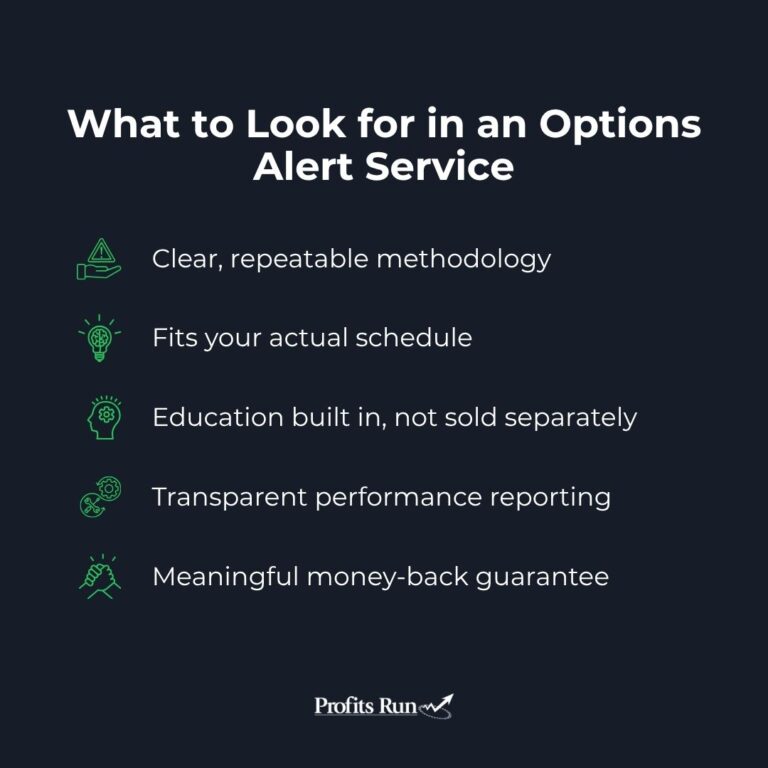
What to Look for in an Options Trading Alert Service
Let’s build a practical framework you can use to evaluate any options trading alert service, whether it’s ours or someone else’s. These are the things that actually matter, based on what we’ve learned running alert services for over 20 years.
A Clear, Repeatable Methodology Behind the Alerts
The first thing to look for is whether the service can explain exactly how it generates its trade recommendations.
The best alert services use rule-based or systematic approaches, not gut feelings or “hot tips.” If a service can’t clearly tell you why they’re recommending a specific trade, what criteria triggered the alert, and what the exit plan looks like, that’s a problem.
Some services use backtested strategies, meaning they’ve run their approach against historical data to see how it would have performed. That’s a reasonable starting point, but backtested results and live results are two very different things. We’ll talk more about that in the red flags section.
At Profits Run, our indicators like the Green Light Accelerator use proprietary algorithms with pre-optimized settings for over 100 stocks and ETFs. The system identifies entries and exits based on specific, repeatable criteria. There’s no guessing involved, and every recommendation follows the same disciplined process.
The key question to ask any service is simple: “Can you explain the rules behind your alerts?” If the answer is vague, move on.
Alerts Designed for Your Actual Schedule
This is one of the most overlooked factors in choosing an alert service, and it might be the most important.
Real-time alerts sound exciting. The idea of getting a notification on your phone and immediately jumping into a trade has a certain appeal to it. But here’s the reality: if you can’t act on an alert within minutes, a real-time alert service is probably not the right fit for your lifestyle.
Think about it. You’re in a meeting at work, or picking up your kids, or just eating lunch. Your phone buzzes with an alert to buy a specific options contract at $3.50.
By the time you actually open your brokerage app and place the order, that contract might be at $4.00 or $4.50. In options trading, that kind of slippage can turn a winning trade into a losing one.
End-of-day alerts let you review setups on your own time, place orders before the next open, and keep your full-time job. You’re not racing the clock. You’re not making rushed decisions. You’re calmly reviewing a trade recommendation in the evening and deciding whether it fits your plan.
This is exactly how our done-for-you services at Profits Run work. Green Light Alerts sends a nightly trade report after the market closes each day.
It includes specific entry and exit instructions, and it takes just a few minutes to review and place your orders. Wave Catcher Alert sends email alerts as setups develop, with contingent orders tied to stock price triggers.
Both are designed so you can spend a few minutes in the evening and get on with your life.
Education Built Into the Service, Not Sold Separately
Here’s something we feel strongly about at Profits Run. If an alert service only tells you what to trade but never explains why, it’s creating dependency, not skill.
The best alert services teach you the reasoning behind each trade. Over time, you start to understand the patterns, the logic, and the decision-making process. You become a better trader, not just a better follower.
If you only copy trades blindly, you’ll never develop the skill to manage positions on your own, adjust when market conditions change, or know when to sit on the sidelines. And when the service inevitably has a losing streak (all of them do), you won’t have the knowledge to handle it well.
All of our products at Profits Run come with step-by-step training videos, quickstart guides, and trading blueprints on the members website. These aren’t afterthoughts. They’re a core part of the experience because we believe education is the foundation of successful trading.
Our support team is also available Monday through Friday, 9 AM to 5 PM EST, to answer questions by phone or email. We don’t just send alerts and disappear.
Transparent Performance and Honest Expectations
Be cautious with any service that leads with flashy return numbers, especially if those numbers seem too good to be true.
A realistic win rate for swing trading options is often in the 50-60% range, and that can absolutely be profitable if the average win is larger than the average loss. A 55% win rate with a 2:1 reward-to-risk ratio means you’re making money over time, even though you’re losing nearly half your trades.
Services claiming 80% or 90% win rates need extra scrutiny. That kind of win rate is possible with certain options selling strategies, but those strategies carry a very different risk profile. Small, consistent wins can be wiped out by a single large loss. High win rates alone don’t tell you the whole story.
Any service that only shows its best trades or cherry-picks results is hiding something. Look for transparency about both winners and losers.
At Profits Run, we’re upfront about this: there is no guaranteed rate of return, and all trading involves risk. Past performance does not guarantee future results.
All performance figures referenced in our materials are hypothetical in nature. We’d rather you have realistic expectations than get excited by promises we can’t keep.
A Money-Back Guarantee That Actually Means Something
A guarantee isn’t just a marketing tool. It tells you something real about how confident a company is in its product.
Look for guarantees that are straightforward. No hoops to jump through. No requirement to show trading records or prove you followed every alert. No fine print that makes it nearly impossible to actually get your money back.
Every Profits Run product is backed by a 90-day money-back guarantee with no trading records or special documentation required. If you’re not satisfied for any reason, you contact us by phone at (248) 733-4343 or email at support@profitsrun.com within 90 days of your purchase, and we process a full refund.
Why does 90 days matter? Because a 90-day window gives you time to test a service across different market conditions, which is something a 7-day trial can never do.
A week of trading in a flat, quiet market tells you almost nothing. Three months gives you a real sample of how the alerts perform when the market is trending, when it’s choppy, and when it’s volatile.
If a service only offers a 7-day trial or no guarantee at all, ask yourself why.
Red Flags That Should Make You Walk Away
Now let’s talk about the warning signs that most review sites will never mention, because the services paying them commissions don’t want you to hear it.
Promises of Guaranteed Returns or "Can't Lose" Systems
This is the single biggest red flag in the entire alert service industry.
No legitimate options trading alert service can guarantee profits. Period. Anyone claiming they have a “risk-free” system or a method that “never loses” is either lying or fundamentally misunderstanding how markets work.
Even the best trading strategies have losing trades. Even the best traders have losing streaks. That’s not a failure of the system. That’s just how probability works in financial markets.
At Profits Run, we tell our members this from day one: only trade with capital you can afford to lose. We recommend risking no more than 2% of your account on any single trade, and 5% maximum for smaller accounts. Risk management isn’t a footnote in our programs. It’s the foundation.
If a service makes you feel like losses aren’t possible, run.
Backtested Results Presented as Live Track Records
This one is subtle, and it catches a lot of people off guard.
Backtesting means running a trading strategy against historical data to see how it would have performed in the past. It’s a useful tool for developing strategies, and we use it ourselves. But backtested results are not the same as live trading results, and any service that blurs that line is being dishonest.
Here’s why backtesting can be misleading. It’s possible to “curve fit” a strategy, meaning you keep adjusting the rules until they perfectly match past data. The strategy looks amazing in hindsight but falls apart in real-time trading because it was optimized for conditions that already happened.
Backtests also tend to assume perfect execution. In real life, you deal with slippage, commissions, and the simple fact that you can’t always get the exact price the backtest assumed.
If a service shows you impressive return numbers, ask a simple question: are those results from actual live trades or from backtesting? The answer matters more than most people realize.
No Clear Risk Management Framework
This is a dealbreaker that doesn’t get nearly enough attention.
Any alert service that tells you what to buy but never mentions position sizing, stop losses, or risk per trade is giving you incomplete information. Knowing when to enter a trade is only half the equation. Knowing how much to risk and when to exit is what keeps you in the game long enough to be profitable.
A good alert service should tell you: how much to risk per trade relative to your account size, when to exit a losing position before it becomes a big loss, and how to size your positions so that no single trade can blow up your account.
Our programs at Profits Run emphasize this from day one. Risk no more than 2% of your account on any single trade. For smaller accounts, that number can go up to 5%, but never higher. That rule alone protects you from the kind of catastrophic loss that forces most traders to quit.
If a service doesn’t talk about risk management, they’re not serious about your long-term success.
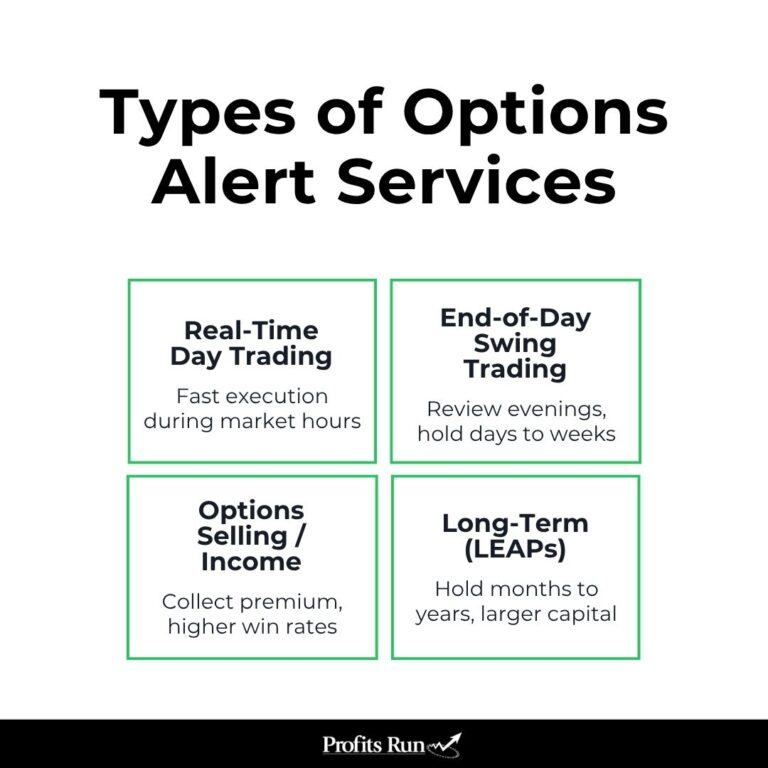
Types of Options Trading Alert Services (And Which One Fits You)
Not all alert services work the same way, and the right one for you depends on your schedule, your experience level, and your goals. Here’s a breakdown of the main types so you can figure out which approach makes sense for your situation.
Real-Time Day Trading Alerts
These services send alerts during market hours and expect you to act quickly, sometimes within seconds or minutes.
The appeal is obvious. You get a trade idea, you execute it, and if it works out, you might be in and out of the position within the same day. Some services focus on 0DTE (zero days to expiration) options, which are the most aggressive and time-sensitive contracts available.
Real-time day trading alerts require you to be available and focused during market hours, which is 9:30 AM to 4:00 PM Eastern. If you have a full-time job, this is extremely difficult to pull off.
You’re either splitting your attention between work and trading (which hurts both), or you’re missing alerts entirely and wondering why your results don’t match what the service promised.
There’s also the slippage problem. By the time you see the alert, open your broker, and place the trade, the price has often moved. In fast-moving options, that delay can be the difference between a winning trade and a losing one.
Day trading alerts can work well for full-time traders with fast execution setups. But for most people with jobs and families, they create more stress than profit.
Swing Trading Alerts (End-of-Day)
Swing trading alerts sent after market close are designed for people who have lives outside of trading. Positions are held for days to weeks, not minutes. You review the alert in the evening, place your orders for the next morning, and go about your day.
This is the approach Profits Run specializes in, and it’s what my father Bill and I have refined over decades of trading and teaching.
Our Green Light Alerts service sends a nightly trade report after the market closes each day. The system runs the Green Light Accelerator algorithm across its universe of stocks, identifies any new entries or exits, and compiles everything into one clear report.
Each report includes the specific options to buy or sell, entry prices, and exit instructions. Members can place their orders in just a few minutes during after-hours or before the next morning’s open.
Wave Catcher Alert works a bit differently. It monitors stocks and sends email alerts as setups develop. Each alert specifies a contingent order to buy a call or put option at a specific limit price, triggered only if the underlying stock hits a certain level. Monthly options are used, and exit alerts are sent for both stop losses and profit targets.
At Profits Run, our done-for-you alert services are built for busy people, and most require just a few minutes per day. You don’t need to watch charts. You don’t need to analyze setups. You just review the recommendation, decide if it fits your plan, and place the order.
Options Selling and Income-Focused Alert Services
Some alert services focus on selling options rather than buying them. This includes strategies like covered calls, credit spreads, and iron condors.
The advantage is that options selling strategies tend to have higher win rates on paper. When you sell an option, time decay works in your favor. If the stock stays within a certain range, you keep the premium you collected.
But higher win rates don’t always mean higher profits. Options selling strategies typically produce small, consistent gains most of the time, paired with occasional large losses when a stock makes a big move against you. A service might win 80% of its trades but still lose money overall if those 20% losers are big enough.
This approach is best for traders with larger accounts who understand how options Greeks work and are comfortable with the risk of assignment.
At Profits Run, we offer the Weekly Profit Window for members interested in this style. It uses credit spreads, which are a defined-risk strategy where your maximum loss is known before you enter the trade. You check the indicator on Friday after the market closes, place orders before Monday’s open, and positions expire that same Friday. It takes about 15-20 minutes per week.
Long-Term Options (LEAPs) Alert Services
LEAPs are options contracts with expiration dates more than a year out. Services that focus on LEAPs typically buy deep-in-the-money call options on stocks they believe will appreciate over the long term.
The advantage is less time commitment and less sensitivity to short-term price swings. The disadvantage is that LEAP contracts are expensive (often $1,000 to $2,000+ per contract), which means you need a larger account to participate.
LEAPs can be a useful strategy for certain investors, but they’re less relevant for everyday traders looking for consistent, shorter-term results. If your goal is to generate regular income from trading or to build skills over time, a swing trading approach is usually a better fit.
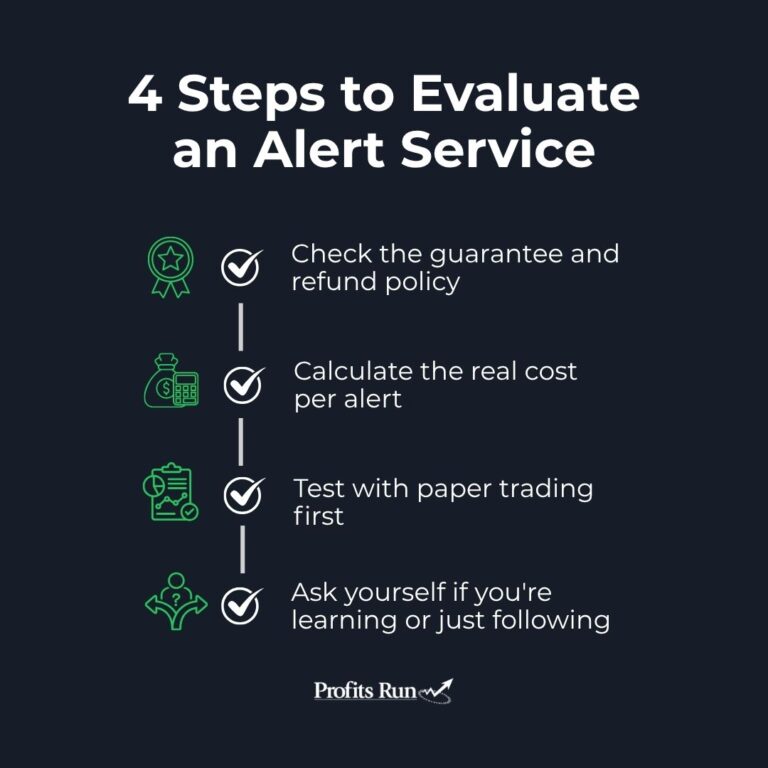
How to Evaluate an Alert Service Before You Subscribe
You now know what to look for and what to avoid. Let’s put that into a step-by-step process you can follow before spending a dollar on any alert service.
Start with the Guarantee and Refund Policy
Before you look at track records or read testimonials, check the refund policy. This one detail tells you a lot.
A company that stands behind its product offers a meaningful guarantee. Not 7 days. Not 14 days. A guarantee long enough for you to actually test the service in real market conditions and see whether it works for you.
At Profits Run, our 90-day money-back guarantee requires no trading records, no proof that you followed every alert, and no special documentation. Just a phone call or email within 90 days, and we process the refund. That’s it.
A company willing to give you 90 days to decide is betting that you’ll be impressed enough to stay. A company that only gives you 7 days is hoping you’ll forget to cancel.
Calculate the Real Cost Per Alert
The monthly subscription fee alone can be misleading. To get a clearer picture of value, divide the monthly cost by the average number of alerts the service sends.
A $150/month service that sends 5 alerts per month costs $30 per alert. A $70/month service that sends 30 alerts costs about $2.30 per alert. That’s a significant difference in what you’re paying for each trade idea.
But cost per alert isn’t everything. The quality of the alerts and whether they fit your trading style matters far more than getting the lowest price. Ten well-researched swing trading alerts that match your account size are worth more than 50 random day-trading signals you can’t execute.
Also consider whether the service matches your account size. For our options-based services at Profits Run, many members start with $5,000 to $10,000. If an alert service recommends $2,000 contracts and you have a $5,000 account, you’ll be risking too much on each trade regardless of how good the alert is.
Test with Paper Trading First
Before risking real money, follow the alerts on paper for a few weeks.
This means tracking the recommended entries and exits in a spreadsheet or trading journal without actually placing any real trades. Record the recommended entry price, the price you would have gotten based on when you saw the alert, and the exit price.
This exercise shows you three things. First, whether the alerts are clear enough to actually execute. Second, whether the timing works with your schedule. And third, whether the results hold up when you account for the small delays between seeing an alert and being able to act on it.
If the service’s alerts aren’t specific enough for you to paper trade, that’s a problem right there.
Check Whether You're Learning or Just Following
After 30 days with any alert service, ask yourself this question: do I understand why these trades are being made?
If the answer is no, the service is a crutch. You’re not becoming a better trader. You’re just paying someone to make decisions for you, and when they have a bad stretch (and they will), you won’t have the knowledge to adjust.
The best alert services make you a more capable trader over time, not a more dependent one. After a few months, you should have a better understanding of the market, the strategies being used, and why certain setups work better than others.
All Profits Run products include training materials because we believe in this principle. The alerts are valuable, but the education that comes with them is what creates lasting results.
How Profits Run's Options Alert Services Compare
We’ve spent this entire article building a framework for evaluating alert services. Now let’s apply that same framework to our own products. We’re going to be honest about what we do well and upfront about who we’re not built for.
Our Approach: Done-for-You Alerts with Built-In Education
Profits Run offers several alert services, each built on proprietary indicators developed by my father Bill with over 50 years of trading experience since 1974.
Green Light Alerts runs the Green Light Accelerator algorithm across its stock universe each day. After the market closes, the system identifies new entries or exits and compiles a nightly trade report emailed to all members. Each report includes specific options to buy or sell, entry prices, and exit instructions. Members can place their orders in a few minutes during after-hours or before the next morning’s open. No chart analysis required.
Wave Catcher Alert monitors stocks and sends email alerts when trade setups are identified. Each alert specifies a contingent order to buy a call or put at a specific limit price, triggered only if the underlying stock hits a certain level. Monthly options are used. Exit alerts are sent for stop losses and profit targets.
Weekend Breakout Alerts is for traders who prefer stocks over options. No options involved at all. It’s the simplest approach we offer.
Weekly Profit Window is for members interested in credit spreads. It’s a defined-risk strategy where your maximum loss is known before entering the trade. Check the indicator Friday evening, place orders before Monday’s open, and positions expire that same Friday. About 15-20 minutes per week.
Every product comes with step-by-step training videos, quickstart guides, and trading blueprints. Our support team is available by phone and email Monday through Friday, 9 AM to 5 PM EST. A free TradingView account is all you need for our indicator-based products.
Who Our Alert Services Are Built For
Our services are designed for a specific kind of person, and we’ve been refining that focus for over two decades.
If you have a full-time job and can spend a few minutes per day on trading, our alert services were built for you. Green Light Alerts and Wave Catcher Alert both require just a few minutes of your evening. Weekly Profit Window takes about 15-20 minutes once per week on Friday.
If you’re a beginner who wants clear, specific trade instructions while you learn the fundamentals, our done-for-you services are a good starting point. They remove the guesswork while the included training materials help you build real skills over time.
If you’ve been trading on emotion, or chasing hot tips on social media, or trying to time the market with no system, our rule-based approach brings structure and discipline to your trading.
And if you want a systematic, repeatable process rather than a guru telling you what he “thinks” the market will do tomorrow, you’ll appreciate how our indicators work. Every alert follows the same criteria. No gut feelings. No opinions. Just data.
What We Don't Do (And Why)
We think being honest about our limitations is just as important as talking about our strengths.
We don’t promise guaranteed returns because no honest service can. There is no guaranteed rate of return, and all trading involves risk. Anyone who tells you otherwise is not being straight with you.
We don’t show only our best trades. Every strategy has losing trades, including ours. We’d rather you understand that upfront than feel blindsided the first time an alert doesn’t work out.
We don’t require long-term contracts or make it hard to leave. Our 90-day money-back guarantee means you can test any Profits Run product in real market conditions before committing. No trading records. No special documentation. No hassle.
We don’t leave you on your own after you subscribe. Our support team answers phones and emails during business hours because we believe real people deserve real support, not a chatbot and a FAQ page.
And we don’t offer 0DTE options, aggressive day trading signals, or strategies that require you to be glued to a screen during market hours. If that’s what you’re looking for, we’re not the right fit, and that’s OK. We’d rather you find the right service for your needs than subscribe to ours and be frustrated.
Questions to Ask Before You Choose Any Options Alert Service
Let’s address some of the most common questions people ask when they’re trying to decide whether an alert service is right for them.
Are Options Trading Alert Services Worth It?
For the right person with the right expectations, yes. For someone expecting guaranteed profits with no effort, no.
Alert services are worth it when they save you time, teach you skills, and provide a systematic edge you wouldn’t have on your own. A good service does the heavy lifting of analysis and scanning so you can focus on execution and learning.
They’re not worth it if you treat them as a magic solution and never bother to learn the underlying strategy. Alerts are a tool, not a substitute for understanding.
The real question isn’t “are alert services worth it?” It’s “is this specific service worth it for my goals, my schedule, and my account size?” That’s a question only you can answer, but the framework in this article should help you get there.
Can You Make Money Following Trading Alerts?
You can, but nothing about it is guaranteed.
Your results depend on several factors: how well you execute the trades, how consistently you follow the risk management rules, how you handle losing streaks emotionally, and what the market conditions look like during the time you’re subscribed.
Following alerts from a disciplined, systematic service gives you a better foundation than trading on emotion or tips from social media. But you still need to manage your positions properly, size your trades appropriately, and have realistic expectations about what’s possible.
The goal isn’t to get rich on a single trade. It’s to build a consistent, repeatable process that grows your account over time.
How Do I Know If an Alert Service Is a Scam?
Look for these warning signs: guaranteed returns, fake urgency and countdown timers, no verifiable information about who runs the service, and no refund policy or a refund policy buried in fine print.
If you can’t find basic information about the company, the people behind it, or how to contact them, that’s a major red flag.
Profits Run has been serving traders for over two decades. We have a real team, a real phone number, a real address, and thousands of active members using our indicators and alert services. We’re a registered publishing and research firm, and every product is backed by our 90-day guarantee.
Transparency isn’t a bonus feature. It’s the bare minimum you should expect.
What's the Difference Between an Alert Service and a Trading Course?
Courses teach you skills and concepts. Alert services give you specific trade recommendations to act on.
The best option is a service that combines both, because alerts without education create dependency, and education without practice stays theoretical. You want to learn and earn at the same time.
At Profits Run, every alert service comes with training materials built in. You’re not just getting trade recommendations. You’re building your understanding of the strategy, the market, and the decision-making process behind each alert.
If you have to choose between a course and an alert service, education comes first. But with the right provider, you don’t have to choose.
The Bottom Line on Options Trading Alert Service Reviews
Most options trading alert service review sites are built to sell you someone else’s product for a commission. This guide was built to help you make a smarter, more informed decision on your own terms.
The best alert service for you depends on your schedule, your account size, your experience level, and your willingness to learn. There’s no universal “best” service. There’s only the best service for your specific situation.
Here’s what to look for: a clear methodology behind the alerts, delivery timing that matches your lifestyle, education built into the experience, transparent and realistic performance claims, solid risk management guidance, and a money-back guarantee that gives you real time to evaluate.
Here’s what to avoid: guaranteed return promises, backtested results disguised as live performance, high-pressure sales tactics, and any service that tells you what to buy but never talks about risk.
At Profits Run, we’ve spent over two decades building alert services for everyday traders. Our approach is built on end-of-day swing trading, proprietary indicators refined over 50+ years of trading experience, and a 90-day money-back guarantee because we believe you should see results before you commit.
If you’d like to explore what we offer, we’re here for you. And if a different service turns out to be a better fit for your needs, we’d honestly rather you find the right one than subscribe to the wrong one.
That’s the kind of advice you won’t find on most review sites.
Ready to see how a rule-based, education-first options alert service actually works?
Explore Profits Run’s done-for-you alert services, all backed by our 90-day money-back guarantee.