
The Best Trading Strategy for Beginners: A Detailed Guide
If you’re trying to decide between scalping and swing trading, here’s what nobody else is telling you: scalping looks exciting on social media, but swing trading is the clear winner for 95% of beginners.
Most people get drawn to scalping because they see traders posting screenshots of dozens of winning trades in a single morning. The appeal is obvious. Quick profits, constant action, and the feeling of being in the game every second.
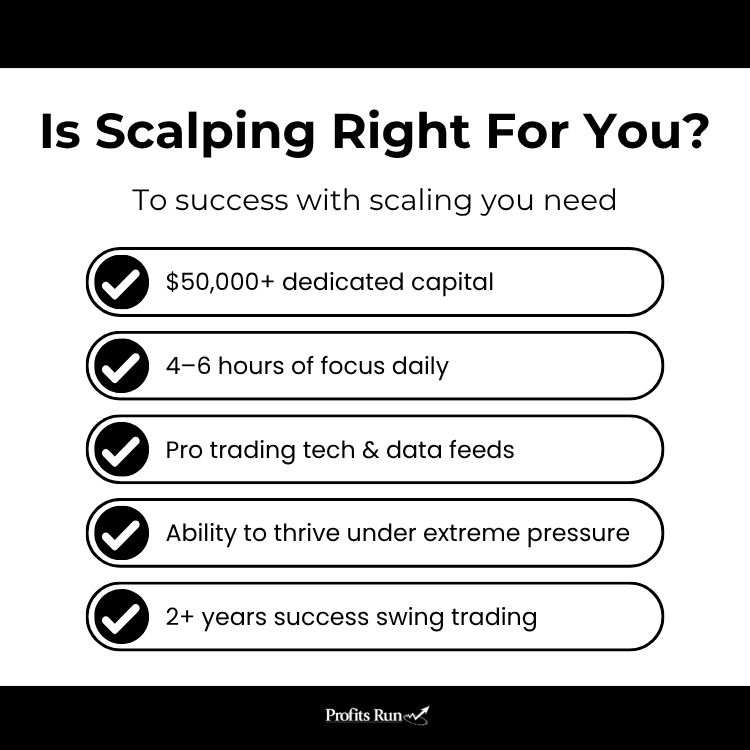
But here’s the reality we share with every new trader who asks us: scalping has a 90% failure rate among beginners, requires $50,000+ in capital, and demands 4-6 hours of continuous, intense focus daily.
That’s not sustainable for someone working full-time, raising a family, or just starting their trading journey with a few thousand dollars.
In this guide, you’ll learn the real differences between scalping and swing trading, including time requirements, capital needs, success rates, and how options fit into both strategies. We’ll give you the honest comparison you need to make a smart decision about which path fits your life.
Ready to Start Trading on Your Own Terms?
Get the exact strategies thousands of everyday traders use to build trading skills while maintaining their full-time jobs and family commitments.
The Critical Difference Between Scalping and Swing Trading
The difference between scalping and swing trading isn’t just about speed. These are fundamentally different approaches requiring different skills, personalities, and lifestyles.
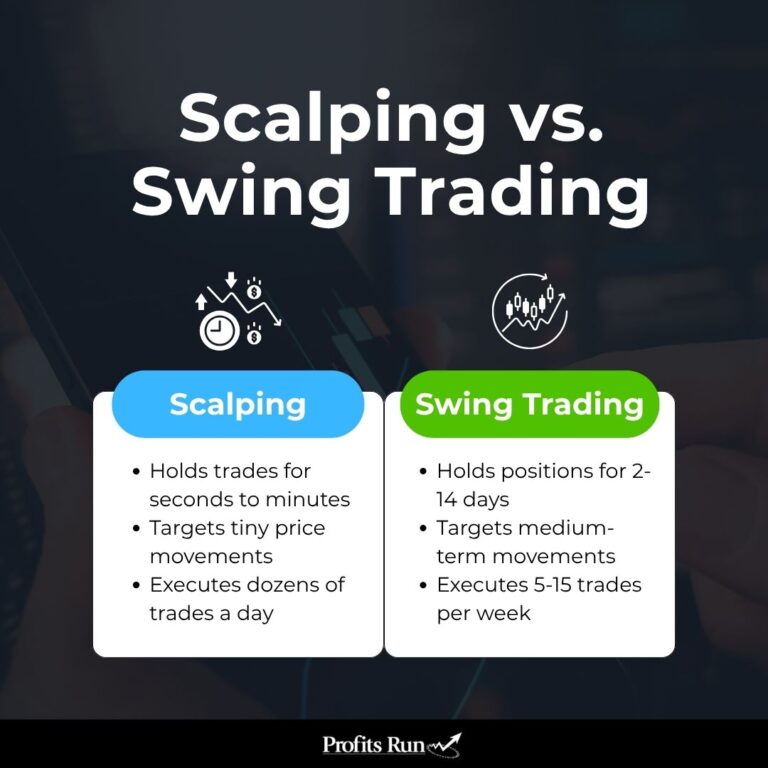
Scalpers hold trades for seconds to minutes, targeting tiny price movements with large position sizes. They might execute 50-200 trades in a single day, trying to capture $0.05 to $0.25 per share on each trade.
Swing traders hold positions for 2-14 days, capturing medium-term price movements. They typically take 5-15 trades per week, letting positions develop over several days while checking charts 1-2 times daily.
Here’s a concrete example: A scalper might buy 1,000 shares at $50.00 and sell at $50.10 just minutes later, making $100 on that 10-cent move. They’ll repeat this process dozens or even hundreds of times throughout the day.
A swing trader might buy the same stock at $50 but hold it for five days as it moves to $52.50. One trade, $2,500 profit, checked twice daily instead of watching every tick.
The lifestyle impact is where reality hits hardest.
Scalping requires full-time commitment. You can’t scalp effectively while working another job.
Swing trading is specifically designed to work around your schedule.
If you want a deeper breakdown of what makes a trading method consistently profitable over time, see our guide on the trading strategy for consistent profits.
What Is Scalping?
Scalping means buying and selling securities within seconds to minutes, profiting from tiny price movements that most traders never notice.
The typical scalper needs 50-200+ trades daily just to be profitable. When your profit per trade is $50-150, you need volume to make meaningful daily income.
Scalpers rely on 1-minute charts, order flow data, and Level II market depth information. They’re watching every single tick, every bid and ask, looking for micro-patterns that signal immediate moves.
Here’s what a typical scalping day looks like: You’re at your screens from 9:30 AM to 12:00 PM. You take 100 trades. Seventy of them win $80 each. Thirty lose $120 each. After commissions and fees, you’ve made $500-800 for three hours of intense, unwavering focus.
Is Scalping the Hardest Form of Trading?
Yes. Scalping is objectively the hardest form of trading for beginners, and here’s exactly why.
The psychological demands are brutal. Try maintaining perfect focus and emotional control for 4-6 hours straight while making split-second decisions that impact real money. One moment of hesitation, one revenge trade after a loss, and your entire day’s profits disappear.
The technical barrier is massive. You need professional-grade technology, and you’re competing against algorithms processing thousands of data points per millisecond.
Compare this to other trading styles: Day trading gives you minutes to hours per trade. Swing trading gives you days. Position trading gives you weeks or months. Scalping gives you seconds.
The Hidden Costs of Scalping
The costs of scalping go far beyond commissions, and most beginners never calculate these until they’re already bleeding capital.
Technology requirements: Professional scalping platforms cost $200-500 monthly. Real-time data feeds add $100-300 monthly. A proper multi-monitor setup costs $2,000-5,000. Direct market access platforms and co-location services add another $200-1,000 monthly. You need this infrastructure just to compete.
Transaction costs are the silent killer. At $5-10 per trade and 100 trades daily, you’re spending $500-1,000 just to participate. That’s before you’ve made a single dollar in profit.
Learning curve costs: Most scalpers need 6-12 months of dedicated practice before reaching consistency. During that period, you’re likely losing money while still paying all those technology and transaction costs.
Capital requirements: The Pattern Day Trader rule requires $25,000 minimum in your account. Realistically, you need $50,000+ because with a $25,000 account, a few bad days drop you below the PDT threshold and you’re locked out of trading.
Why Most Beginners Fail at Scalping
The failure rate for beginner scalpers exceeds 90%, and the reasons are predictable.
You’re competing against algorithms designed specifically to identify and exploit the tiny inefficiencies you’re targeting. By the time you see a 10-cent opportunity, institutional algorithms have already acted on it.
One bad trade wipes out 10-20 winners. When your average winner is $80 and your loser is $1,200 because you hesitated on the stop-loss, you just erased hours of perfect execution.
The intensity isn’t sustainable long-term. Most people can’t maintain that level of focus, stress, and emotional control for six months straight.
If you’re working full-time, have family commitments, or have less than $50,000 to dedicate to trading, scalping simply isn’t realistic, no matter what social media gurus tell you.
What Is Swing Trading? (And Why It Works for Beginners)
Swing trading means holding positions for 2-14 days, capturing medium-term price movements as stocks or ETFs swing between support and resistance levels.
You’re trading off daily or 4-hour charts instead of 1-minute ticks. You’re looking for patterns like ascending triangles, flag formations, or bounces off key support levels. You set your entry, stop-loss, and profit target, then let the position develop.
Here’s a concrete example: You identify a stock trading at $48 that’s bouncing off a support level. Technical indicators suggest it could move to $52 resistance.
You enter at $48.50 with a stop-loss at $46.50. Over the next seven days, the stock reaches your $52 target. You’ve captured $3.50 per share without watching it every second.
The analysis happens on your schedule. Check charts before the market opens or in the evening. You don’t need to be glued to screens during market hours because your trades are based on daily or multi-day movements, not second-by-second ticks.
How Long Should You Hold a Swing Trade?
The typical swing trade lasts 2-14 days, though some extend to 3-4 weeks depending on market conditions and the specific setup.
The holding period depends on market volatility, strategy type, and price action. Your strategy type determines duration. Breakout plays might reach targets in 3-5 days. Mean-reversion trades might take 10-14 days.
Here’s the key principle: Hold until you have a technical reason to exit, not based on arbitrary timeframes. Exit when your profit target is hit, when the pattern breaks, or when your stop-loss is triggered.
What Is the 2% Rule in Swing Trading?
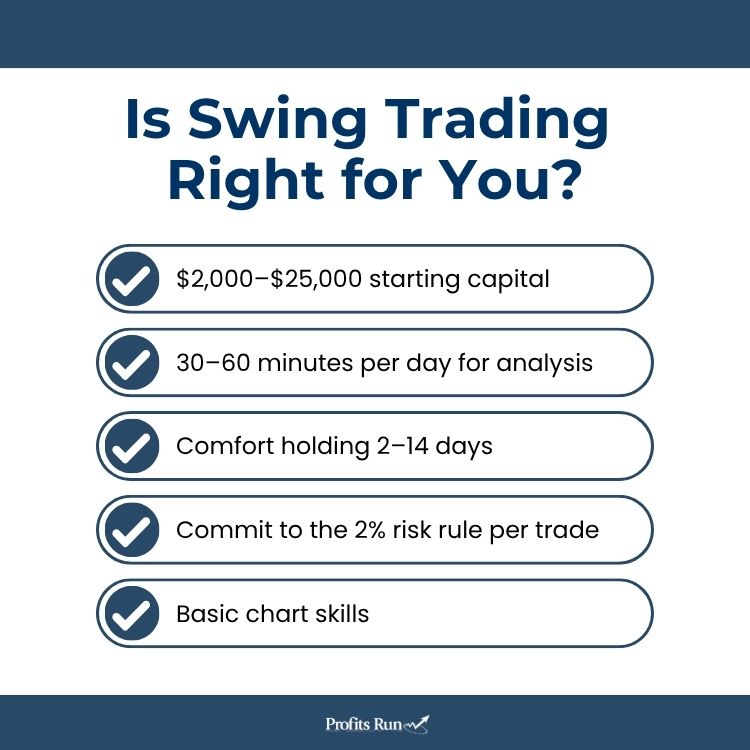
The 2% rule states you should never risk more than 2% of your total account value on any single trade.
Here’s the mathematical example: With a $10,000 account, your maximum risk per trade is $200. That doesn’t mean you invest only $200. It means if your stop-loss gets hit, you lose no more than $200.
How to calculate position size based on stop-loss distance: Let’s say you’re buying a stock at $50 with a stop-loss at $48. Your risk per share is $2. Divide your maximum dollar risk ($200) by your risk per share ($2) to get your position size: 100 shares.
Why this rule protects capital: Imagine ten consecutive losing trades. With the 2% rule, you’re down 20% of your account. With 10% risk per trade, your account is blown.
Options trading makes the 2% rule easier to follow because your maximum loss is defined upfront. When you buy a call option for $300, that $300 is your total risk.
Why Swing Trading Fits Most Beginners
Swing trading was specifically designed for people who have lives outside of trading. You check markets 1-2 times daily, spending 30-60 minutes total.
You have time to think through decisions. There’s no pressure to execute in three seconds or miss the move. You can analyze your setup in the evening, place your entry order with defined stop-loss and profit targets, and go to work the next day knowing your risk is managed.
Swing trading is forgiving of small timing mistakes. If you wanted to enter at $50 but got filled at $50.25, that quarter doesn’t usually break your trade thesis. In scalping, a quarter would eliminate your entire profit potential.
You can work a full-time job while swing trading. Analyze charts before the market opens or after it closes. Place your trades with defined exit points. Check on positions during lunch breaks. This isn’t theoretical. Thousands of our students do exactly this.
Transaction costs are significantly lower. With 5-15 trades weekly instead of 100+ daily, you might spend $50-200 monthly in commissions versus $1,000-3,000 for scalpers. That difference alone changes the profitability equation completely.
One of the most frequent questions beginners ask: “Can I swing trade while working full-time?” Absolutely. Swing trading respects your other commitments because you’re not required to watch every tick.
Unlike scalping, which demands your complete attention for hours, swing trading works around your life instead of consuming it. Learn more on how to choose the best swing trading courses.
What's Better, Scalping or Swing Trading?
For 95% of beginners, swing trading is objectively better across every meaningful dimension. The comparison table below shows exactly why.
Factor | Scalping | Swing Trading |
Holding Period | Seconds to 5 minutes | 2-14 days |
Daily Screen Time | 4-6+ hours continuous | 30-60 minutes |
Trades Per Week | 200-500+ | 5-15 |
Work Full-Time Job? | No | Yes |
Minimum Capital | $25,000-50,000 | $2,000-5,000 (with options) |
Monthly Transaction Costs | $1,000-3,000 | $50-200 |
Time to Profitability | 12-18 months | 3-6 months |
Stress Level | Extremely high | Moderate |
Beginner Success Rate | 5-10% | 40-50% |
A question we hear often: “Which is more profitable, scalping or swing trading?” Both can be profitable, but profitability isn’t just about returns; it’s about risk-adjusted returns.
An average profitable swing trader might make 15-30% annually with moderate stress and part-time effort. An average profitable scalper might achieve similar returns but with 10x the effort, 10x the stress, and a much higher burnout rate.
When you factor in lifestyle cost, transaction costs, and sustainability, swing trading delivers superior risk-adjusted returns for most people.
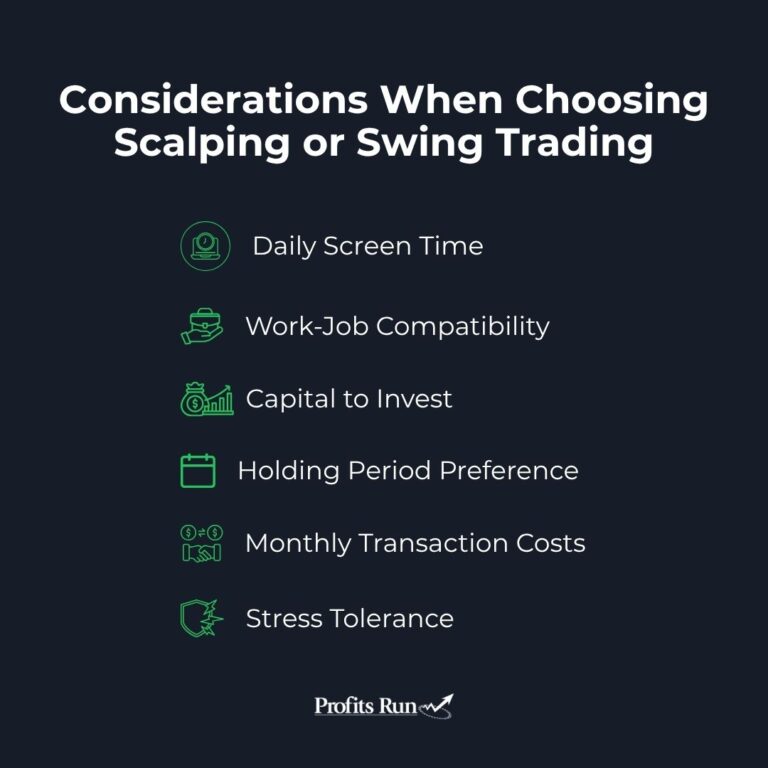
The Psychological Reality: Are You Built for Scalping or Swing Trading?
Your personality and natural tendencies matter more than ambition. Fighting against your natural wiring leads to frustration and losses.
The successful scalper thrives under extreme pressure in ways most people simply don’t. They make split-second decisions confidently without second-guessing.
They don’t need big wins. They’re content with consistency. They think in seconds and ticks, not trends and patterns.
The successful swing trader is patient and analytical. They prefer spending 30 minutes studying a chart to find the perfect entry rather than taking 30 imperfect entries.
They’re comfortable with uncertainty and can hold positions through volatility without panic-selling. They value work-life balance and think in days and weeks, not minutes.
After teaching thousands of students, we’ve learned that personality fit matters more than ambition. If you’re naturally analytical and patient, trying to force yourself into scalping’s high-pressure environment will lead to frustration and losses.
How Options Trading Fits Into Both Strategies
Options enhance swing trading so dramatically that we’ve built our entire methodology around them. For scalping? They’re not worth the added complexity.
Options for Swing Trading (Highly Recommended)
Why options transform swing trading:
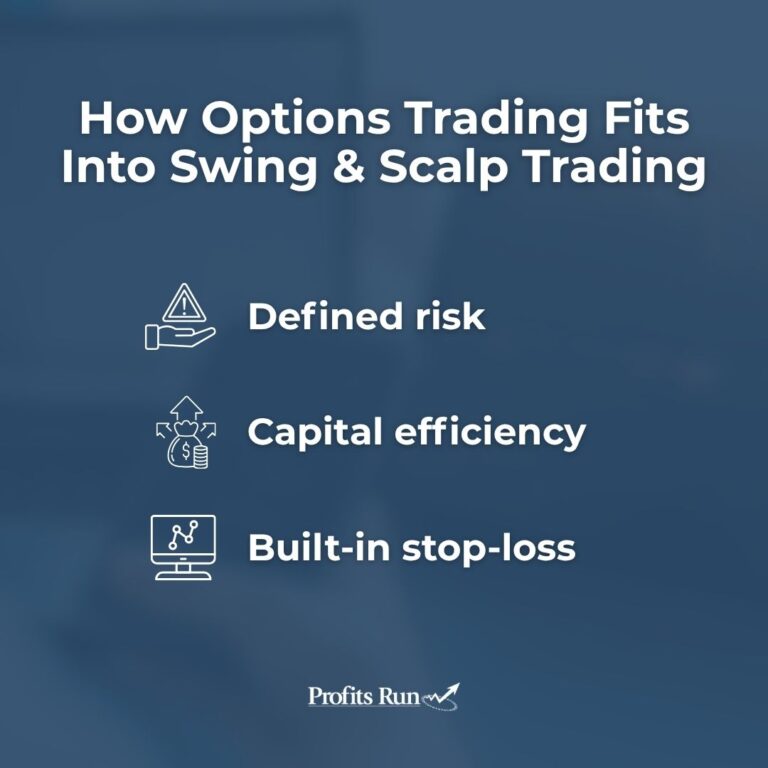
Defined risk on every trade. When you buy a call option for $400, that $400 is your maximum possible loss. The stock could gap down 50% overnight. Doesn’t matter. You can’t lose more than the premium you paid.
Capital efficiency. You can control $10,000 worth of stock with $500 in options. This means you can take properly-sized positions without overleveraging or tying up excessive capital.
Built-in stop-loss. Your maximum loss is defined by the premium paid. You don’t need to worry about stop-loss slippage, gap risk, or overnight disasters.
Here’s a practical example:
Traditional stock approach: Buy 100 shares of XYZ at $75 = $7,500 capital tied up.
Options approach: Buy one call option for $400 controlling the same 100 shares.
If wrong: Max loss = $400 regardless of how far the stock falls.
If right: Similar profit potential with 95% less capital at risk.
Read more about options trading courses.
Options for Scalping (Advanced Only)
We need to be direct: Options scalping is extremely difficult and not recommended for beginners.
The bid-ask spreads on options eat into the tiny profits scalpers target. When you’re trying to capture 10-20 cents and the bid-ask spread is 8 cents, your edge disappears.
Time decay fights you on ultra-short timeframes. Adding options mechanics, Greeks, and spread management creates layers of complexity that increase failure probability.
Why we don’t teach options scalping: It combines the hardest form of trading (scalping) with the most complex instruments (options). That’s a recipe for failure for 99% of beginners.
Making Your Decision: A Clear Framework
You’ve seen the data. You understand the differences. Now let’s make this decision simple with a clear framework based on your actual situation.
Choose Swing Trading If:
- You work full-time or have other commitments
- You have $2,000-25,000 starting capital
- You prefer thoughtful analysis over quick reactions
- You want a sustainable, long-term approach
- You value work-life balance
- You want to use options for capital efficiency
If you checked three or more boxes, swing trading is your answer.
Consider Scalping Only If:
- You have $50,000+ dedicated capital
- Trading will be your full-time job
- You’ve been successful swing trading for 2+ years
- You have professional trading infrastructure
- You thrive under extreme pressure
If you didn’t check every single box, scalping isn’t realistic for you right now.
Can you do both scalping and swing trading? We strongly advise against it. These strategies require completely different mindsets. Mixing them creates confusion and typically results in doing both poorly.
Even after decades in the markets, we’ve observed that the most successful scalpers all mastered swing trading first. Scalping is not where you start your trading journey.
Final Thoughts: Start Smart, Not Fast
After more than 50 years in the markets and teaching thousands of students, we’ve learned one truth: The traders who succeed are those who choose strategies that fit their lives, not strategies that look exciting on social media.
Swing trading isn’t flashy, and it won’t make you a millionaire overnight. But if you’re serious about learning how to earn money from trading, it’s one of the most realistic and sustainable paths. It works, and it gives you a long-term way to build skills that generate income for decades.
Your lifestyle should dictate your strategy, not the other way around. If your chosen trading style doesn’t fit your actual life, you’ll fail regardless of how good the strategy is on paper.
If you’re a beginner reading this, your path to trading success starts with swing trading. That’s not opinion. That’s based on decades of watching what actually works for regular people.
We’ve taught students in over 150 countries. We’ve seen who succeeds and who fails. The pattern is clear: Those who choose swing trading, learn proper risk management, and build skills gradually are the ones still trading five years later.
Ready to start your swing trading journey the right way?
Our programs teach you the exact strategies we use, with step-by-step guidance designed for beginners who want to trade part-time while managing risk properly.
Disclaimer: Trading stocks, options, and other financial instruments involves risk and may not be suitable for all investors. The content provided is for educational purposes only and does not constitute financial advice. Past performance is not indicative of future results. Always conduct your own research and consider consulting with a qualified financial advisor before making trading decisions. Profits Run and its representatives are not liable for any losses incurred from trading activities.